The European Centre for Strategic Studies and Policy (ECSAP)
The European Union of late 2026 is beginning to look fundamentally different from the Union that entered this decade. For years, European integration was driven principally by the construction of rules: competition law, environmental standards, fiscal frameworks, consumer protections, trade agreements and the progressive removal of barriers inside the Single Market. The EU became extraordinarily influential by regulating the world’s largest integrated market, but it remained comparatively weak whenever power required speed, concentrated investment, military capability, technological scale or geopolitical coercion. The strategic shocks of the 2020s have exposed the limits of that model. Russia’s war against Ukraine, competition with China, uncertainty surrounding the United States, high energy prices, technological dependence, migration pressure and the possibility of a substantially larger Union are now forcing Brussels to reconsider not simply individual policies but the political operating system of European integration.
The European Council of 15–16 October 2026 made this transformation unusually visible. EU leaders placed competitiveness, the Single Market, industrial policy, energy prices, the next seven-year budget, defence, migration, enlargement and institutional reform within the same strategic conversation. They demanded faster permitting, fewer administrative burdens, deeper market integration and progress on a new European company-law regime, while simultaneously discussing how the Union should finance its priorities after 2027 and how its institutions would function after another round of enlargement. The common thread connecting these apparently different subjects is increasingly clear: Europe believes that fragmentation has become a strategic vulnerability.
This represents a significant political shift. The old European policy question was frequently whether additional EU-level regulation was required to correct a market, environmental or social problem. The emerging question is whether Europe possesses sufficient capacity to act. Can a European company scale across the Single Market as easily as an American company scales across the United States? Can the Union mobilise private savings for strategic investment? Can it approve infrastructure rapidly enough to compete internationally? Can it secure affordable energy while maintaining climate objectives? Can 27 governments take geopolitical decisions quickly enough during crises? Can a future Union of more than 30 members operate under institutions originally designed for a much smaller community?
The answer Brussels is developing is not classical federalism, nor is it a return to national sovereignty. Instead, Europe appears to be constructing a more complicated hybrid: national governments retain decisive political authority, but the EU increasingly develops common instruments wherever fragmentation reduces European power. This is visible in defence procurement, industrial policy, energy coordination, economic security, migration management, capital markets, technology policy and the emerging debate over the next Multiannual Financial Framework. The Union is gradually moving from regulating national capacities toward aggregating them.
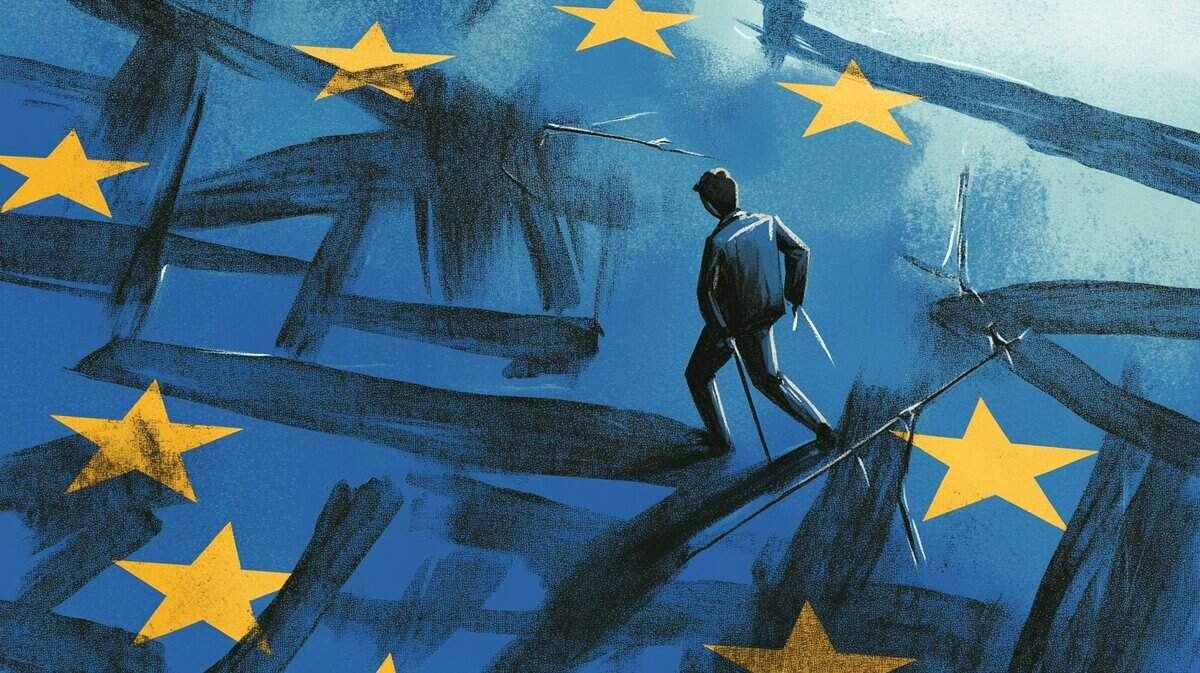
For the European Centre for Strategic Studies and Policy (ECSAP), the central argument of this paper is that 2026 marks an important transition from the European Union as primarily a regulatory power toward something closer to a strategic political system. Whether this transformation succeeds will depend on five interconnected battles: completing the Single Market, reconciling competitiveness with regulation, building a budget capable of financing geopolitical ambitions, reforming decision-making before enlargement and managing the political conflict between European collective capacity and national control. These are not separate policy debates. Together, they will determine whether Europe remains one of the institutions shaping the twenty-first-century international order or becomes primarily a wealthy but increasingly constrained market operating inside an order shaped by others.
The European Model Has Reached Its Strategic Limits
The EU’s regulatory power was never insignificant. On the contrary, it became one of Europe’s greatest international assets. Access to a market of hundreds of millions of relatively wealthy consumers allowed Brussels to establish standards that companies around the world often adopted because producing separate products or systems exclusively for Europe was commercially inefficient. European competition policy could challenge some of the world’s largest corporations. Environmental and data-protection legislation influenced global business practices. Trade agreements extended European standards beyond EU borders. Regulation effectively converted the size of the Single Market into geopolitical influence.
The problem is that regulation works best in a world where markets remain relatively open, international economic relations are primarily commercial and security can be treated separately from economics. That world has weakened dramatically. The United States increasingly uses subsidies, export controls and industrial policy to protect strategic capabilities. China combines enormous manufacturing scale with state-backed investment and control over important supply chains. Russia demonstrated that energy relationships can become instruments of geopolitical coercion. Semiconductors, batteries, cloud infrastructure, artificial intelligence, critical minerals, telecommunications and even ordinary industrial capacity are now treated as components of national power. In such an environment, Europe cannot assume that establishing the world’s most sophisticated rules automatically produces the companies, technologies and industrial capacity required to exercise power.
This concern now sits at the centre of EU politics. The October European Council called for deeper Single Market integration, faster permitting, reduced administrative burdens, industrial renewal, affordable energy and greater mobilisation of investment. Leaders explicitly demanded “legislative and regulatory self-restraint,” language that would have been politically unusual during earlier phases of European integration, when regulatory expansion was frequently treated as evidence of institutional progress. The significance is not that Europe has suddenly rejected regulation. Environmental, social and consumer protections remain fundamental elements of the European political model. What is changing is the recognition that the cumulative economic cost of regulation must be considered alongside its individual policy benefits.
The simplification agenda developing during 2026 illustrates this shift. On October 21, the Council adopted a negotiating position intended to reduce administrative obligations for smaller packaging producers, while the European Parliament had also backed simplified requirements for small businesses. Individually, such measures may appear technical. Collectively, however, they form part of a larger political reassessment: Europe is beginning to ask whether a system designed to regulate economic activity has accumulated enough complexity to inhibit the economic dynamism on which the social model itself ultimately depends.
The challenge is politically delicate because “simplification” can mean very different things. For business, it can mean eliminating duplicative reporting, shortening permit procedures and harmonising national requirements. For environmental organisations or trade unions, the same language can create concern that competitiveness will become a justification for weakening environmental or social protections. The strategic challenge for Brussels is therefore not deregulation in the traditional sense. It is creating a regulatory state capable of distinguishing between rules that protect legitimate European objectives and administrative complexity that produces little strategic or social benefit.
The Single Market Is Becoming a Geopolitical Project
The Single Market is usually described as an economic achievement, but in the world of 2026 it increasingly functions as a strategic instrument. Europe possesses world-class companies, enormous private savings, advanced universities, sophisticated infrastructure and a large consumer base. Yet these assets remain divided by national rules, capital markets, tax systems, corporate structures, procurement practices and regulatory differences. The result is a peculiar European contradiction: the Union possesses continental scale in theory while companies often experience national fragmentation in practice.
The October European Council therefore placed the “One Europe, One Market” agenda near the centre of its competitiveness strategy. Among the initiatives being advanced is a so-called 28th regime for company law, sometimes associated with the concept of “EU Inc.” The basic logic is strategically significant. Instead of requiring an ambitious company to navigate different corporate regimes as it expands across member states, Europe would create an optional common European framework capable of facilitating cross-border growth. Leaders also pushed forward market integration and supervision, the Savings and Investment Union, the Industrial Accelerator Act, the European grids package and additional measures designed to remove barriers inside the Single Market.
This matters because Europe’s economic competition with the United States and China is fundamentally a competition over scale. A technology company established in California can access an enormous domestic market under one broad corporate and financial system. A Chinese manufacturer can benefit from a vast integrated industrial base and powerful state coordination. A European company may begin in France, Sweden, Germany or Italy and discover that expanding across Europe still requires navigating different legal, financial and administrative systems. Europe therefore risks producing innovation without producing global champions at comparable scale.
Capital is another part of the same problem. European households hold enormous savings, but a significant share does not flow toward European high-growth companies or strategic investment. Fragmented capital markets make it harder for businesses to obtain the financing required to scale. This helps explain why the Savings and Investment Union has become more than a financial-sector reform. It is increasingly being treated as part of European strategic capacity. If Europe cannot mobilise its own savings for its own technological, industrial, energy and defence transformation, it will remain dependent on either public budgets or foreign capital.
The political consequence is important. Completing the Single Market used to be presented primarily as a method for improving efficiency and consumer choice. It is now becoming an element of sovereignty. Every remaining internal barrier reduces the scale Europe can bring to competition with larger powers. The Single Market is therefore no longer merely Europe’s economic foundation. It is becoming the platform through which the Union attempts to convert economic size into geopolitical power.
The €2 Trillion Question: Europe’s Ambitions Are Larger Than Its Budget
The next major battle concerns money. The European Commission has proposed a long-term EU budget for 2028–2034 approaching €2 trillion, but negotiations have exposed a fundamental contradiction between expanding European ambitions and the willingness of national governments to finance them. Germany, Denmark, Finland, the Netherlands and Austria argued in September that the proposed budget should be reduced by several hundred billion euros. The dispute is not simply about accounting. It goes to the heart of what kind of political institution the EU intends to become.
Europe wants to finance defence readiness, Ukraine, infrastructure, technological development, energy transformation, border management, agricultural support, cohesion, enlargement and strategic industries. Many governments simultaneously want to contain public expenditure and protect national control over taxation. Those objectives cannot all be maximised at once. A Union with expanding geopolitical responsibilities but a budget designed primarily for the policy priorities of an earlier era will eventually confront a capability gap between what political leaders promise and what European institutions can deliver.
The October European Council therefore treated agreement on the next Multiannual Financial Framework as strategically urgent, seeking a deal before the end of 2026 so that the necessary legislation can be completed during 2027 and funding can begin without interruption in January 2028. Behind the timetable lies a deeper political battle over redistribution. Traditional beneficiaries of agricultural and cohesion spending do not want those programmes weakened to finance defence or technology. Net contributors resist dramatic increases in national payments. Candidate countries will eventually require financial integration. Ukraine’s reconstruction and potential membership would further transform the budgetary equation.
The EU consequently faces a choice that European politics has repeatedly postponed: either increase common financial capacity, reduce the number of ambitions financed at European level, or redirect spending from established programmes toward new strategic priorities. Every option creates political opposition. Raising common resources touches national fiscal sovereignty. Cutting traditional programmes creates winners and losers among member states and regions. Limiting ambitions undermines claims that Europe is becoming a geopolitical actor.
This is why the budget negotiations may become one of the most important political conflicts in the Union. Budgets reveal priorities more accurately than declarations. Europe can describe defence, technological sovereignty, enlargement and competitiveness as existential objectives, but those claims become strategically meaningful only when financial resources follow them. The 2028–2034 framework will therefore reveal whether the EU’s geopolitical transformation is structural or largely rhetorical.
Enlargement Is Forcing Europe to Confront Its Institutional Architecture
A second transformation is occurring simultaneously. Enlargement has returned from the margins of European policy to the centre of European strategy. The October European Council again described enlargement as a “geostrategic investment” in peace, security, stability and prosperity, while emphasising that both candidate states and the EU itself must be ready for accession. It specifically connected future enlargement with internal reform and the Union’s capacity to act. This is an important admission: Europe cannot simply enlarge its existing political machinery indefinitely without considering how that machinery functions.
A Union of more than 30 states would be geographically larger, strategically stronger and potentially more influential. It would also be more heterogeneous. Differences in economic development, security priorities, relations with Russia, agricultural interests, fiscal preferences and political culture would expand. Decision-making procedures that are already difficult among 27 governments could become significantly more cumbersome. Unanimity in sensitive policy areas would give additional governments veto power. Budget negotiations would become more complex. Representation inside European institutions would require adjustment.
This creates one of the central dilemmas of European politics in the late 2020s. Enlargement is increasingly viewed as strategically necessary precisely when institutional complexity makes enlargement more difficult. Ukraine, Moldova and Western Balkan candidates cannot remain indefinitely in a geopolitical waiting room without consequences for European credibility and security. But bringing additional countries into a Union that has not adapted its decision-making structures could reduce the very capacity Europe is attempting to strengthen.
The emerging debate will therefore increasingly concern differentiated integration. Not every member may participate in every European policy to the same degree or at the same speed. The euro and Schengen already demonstrate that European integration can operate through overlapping circles rather than complete uniformity. Future enlargement could push this logic much further, producing a Union with a strongly integrated core surrounded by different layers of participation in defence, currency, migration, energy, industrial policy and foreign affairs.
Such an outcome would challenge the traditional political assumption that all EU members ultimately move toward essentially the same destination. Yet it may become necessary if Europe wants to combine geopolitical expansion with effective decision-making. The alternative could be a larger Union possessing greater territory and population but less ability to act collectively.
The Political Centre of Gravity Is Moving from Rules to Results
The deeper transformation connecting these policies is a change in what Europeans increasingly expect from Brussels. The legitimacy of the EU was historically built partly around process: common rules, predictable institutions, legal integration and gradual convergence. The crises of the 2020s have shifted expectations toward outcomes. Citizens and governments increasingly ask whether Europe can keep energy affordable, protect borders, support Ukraine, strengthen defence, compete technologically, preserve industrial jobs and respond rapidly to geopolitical shocks.
European Council President António Costa described the October summit as advancing an agenda focused on competitiveness, security and Europe’s ability to act. This language reflects a broader political transition. Europe is moving from a model in which institutional success could often be demonstrated by adopting legislation toward one in which success increasingly requires measurable strategic capacity.
That transition carries risks. A politics obsessed with speed and effectiveness can weaken deliberation, legal safeguards or minority protections. Calls to overcome vetoes can be interpreted by smaller states as attempts by larger countries to dominate European policy. Industrial policy can degenerate into subsidy competition if not coordinated effectively. Simplification can become deregulation if poorly designed. Strategic autonomy can become protectionism. The challenge is therefore not simply to make Europe more powerful but to make it more capable without abandoning the legal and democratic characteristics that distinguish the European model.
There is also a distributional problem. Strategic Europe will create winners and losers. Faster industrial development may benefit regions with existing manufacturing clusters. Defence spending may advantage particular countries and companies. Energy infrastructure requires investment whose costs are distributed unevenly. Capital-market integration may challenge national financial traditions. Enlargement will redistribute EU funds and political influence. Every strategic policy therefore contains a domestic political economy.
The Union’s transformation cannot succeed if citizens perceive “European sovereignty” primarily as a project benefiting institutions, corporations or metropolitan regions while households absorb higher costs. Competitiveness must eventually translate into wages, employment, investment and affordable energy. Strategic capacity requires public legitimacy.
The Real Battle of 2026 Is Over What Europe Wants to Become
Europe’s political debate is often described as a conflict between federalists and nationalists. That distinction increasingly fails to capture what is actually happening. Many governments that resist a federal Europe simultaneously demand stronger European action on borders, defence, energy, industrial competition or trade. Conversely, governments that support deeper integration can resist European intervention when it threatens important national industries or fiscal interests.
The emerging political model is therefore more transactional. Governments increasingly ask where European scale produces greater national power. When the answer is obvious—such as trade negotiations, sanctions, strategic supply chains or parts of defence procurement—they may accept stronger common instruments. Where national control remains politically valuable, they resist centralisation.
This could produce a European Union that becomes stronger without becoming conventionally federal.
Brussels may acquire more financial instruments, operational agencies, industrial-policy tools and regulatory coordination while national capitals retain control over taxation, military deployment and central elements of social policy. Integration would proceed through practical necessity rather than constitutional design.
The October 2026 agenda strongly points in this direction. Competitiveness requires common markets. Energy security requires interconnected infrastructure. Defence requires industrial scale. Migration requires management of common external borders. Enlargement requires institutional reform. Technology requires continental investment. Each challenge pushes governments toward greater European coordination even when political rhetoric remains strongly national.
The paradox is that geopolitical fragmentation outside Europe may accelerate political integration inside it.
Conclusion: From Regulatory Europe to Strategic Europe
The European Union has spent decades becoming exceptionally good at establishing rules. The next phase of European integration will be determined by whether it can become equally capable of mobilising resources, making decisions and producing strategic outcomes.
The transformation underway in 2026 does not mean the regulatory Europe is disappearing. The Single Market still depends on common rules. Environmental standards remain central to European policy. Competition law, consumer protection, social standards and the rule of law remain essential components of the European model. The strategic change lies elsewhere: regulation is increasingly being judged according to whether it strengthens or weakens Europe’s capacity to act.
That shift explains why simplification, competitiveness, energy, industrial policy, capital markets and permitting have moved to the centre of European politics. It explains why leaders are discussing the next EU budget as a geopolitical instrument rather than merely a mechanism for distributing agricultural and regional funds. It explains why enlargement is now inseparable from institutional reform. And it explains why the Single Market is increasingly being discussed not simply as an economic achievement but as the scale Europe requires to remain globally relevant.
The October European Council captured this transition with unusual clarity. Leaders demanded progress on the 28th company-law regime, industrial acceleration, energy grids, regulatory simplification and capital-market integration while simultaneously confronting high energy prices, negotiating the next long-term budget and discussing how enlargement should interact with internal EU reform. These are not isolated files. They are different components of a single political transformation.
Europe is discovering that sovereignty in the twenty-first century is not defined only by who possesses formal legal authority. It is defined by who possesses the capacity to act.
A state may legally control industrial policy but lack the market size required to compete with China. It may formally control defence procurement but lack sufficient domestic demand to sustain an advanced defence industry. It may control energy policy while remaining exposed to international price shocks. It may possess national capital markets too small to finance global technology companies.
Pooling capacity can therefore increase effective sovereignty even when it reduces exclusive national control.
This idea may become the political foundation of the next phase of European integration.
The challenge will be convincing governments and citizens that stronger common capacity does not necessarily mean a centralised European superstate. Europe’s future may instead depend on a more pragmatic bargain: decisions should remain national where national action remains effective, while powers, resources and markets should be combined where fragmentation makes every European country weaker.
The next EU budget will test that bargain financially. Enlargement will test it institutionally. Competitiveness will test it economically. Defence and geopolitical crises will test it strategically.
Failure would not necessarily produce the collapse of the European Union. The more plausible danger is gradual relative decline: Europe would remain prosperous, democratic and influential but become increasingly dependent on decisions taken in Washington, Beijing and elsewhere. Reuters commentary in October captured the urgency surrounding the reform debate, warning that failure to implement long-discussed competitiveness reforms risks pushing Europe toward long-term comparative decline.
Success would produce something different from either the old EU or a classical federal state.
It would create a Union capable of using the Single Market as strategic scale, private savings as investment power, common budgets as geopolitical instruments, industrial policy as security policy and enlargement as an extension of European stability. National states would remain central, but their ability to exercise power would increasingly depend on the European structures surrounding them.
That is the political transformation taking place beneath the technical language of Brussels in 2026.
The debate over company law is really a debate about scale. The argument over administrative burdens is really a debate about competitiveness. The fight over the €2 trillion budget is really a debate about geopolitical ambition. The discussion about enlargement is really a debate about Europe’s future borders and institutions. And the pressure to reform decision-making is ultimately a debate about whether a Union constructed to manage integration during an era of relative stability can exercise power during an era of geopolitical competition.
For the European Centre for Strategic Studies and Policy (ECSAP), the strategic conclusion is that Europe’s central challenge is no longer deciding whether it wants greater sovereignty. European leaders across much of the political spectrum already speak the language of sovereignty, resilience and strategic autonomy.
The real question is whether Europe is willing to build the political machinery required to exercise them.
If 2022 forced Europe to rediscover geopolitics, 2026 is forcing it to redesign governance. The outcome will determine whether the European Union enters the 2030s primarily as the world’s most sophisticated regulatory market—or as a political power capable of converting its enormous economic weight into strategic action.