The European Centre for Strategic Studies and Policy (ECSAP)
The rapid expansion of Russia’s shadow fleet has demonstrated that modern sanctions are no longer challenged solely through political resistance or diplomatic alliances. Instead, they are increasingly contested through highly adaptive commercial logistics. What initially emerged as a temporary response to Western restrictions has evolved into a sophisticated maritime network capable of maintaining Russian energy exports while minimizing exposure to the financial and regulatory systems traditionally dominated by Western governments. This transformation represents one of the most significant adaptations of global maritime commerce in recent decades.
Unlike conventional merchant fleets operated by large international shipping companies, the shadow fleet functions through decentralized commercial structures specifically designed to complicate transparency and accountability. Ownership of vessels is frequently transferred between newly established companies registered in multiple jurisdictions, making it difficult for regulators to identify the ultimate beneficial owners. Tankers often change their registered flags, insurance providers, technical managers, and commercial operators within relatively short periods, creating a constantly shifting legal and administrative framework that complicates sanctions enforcement.
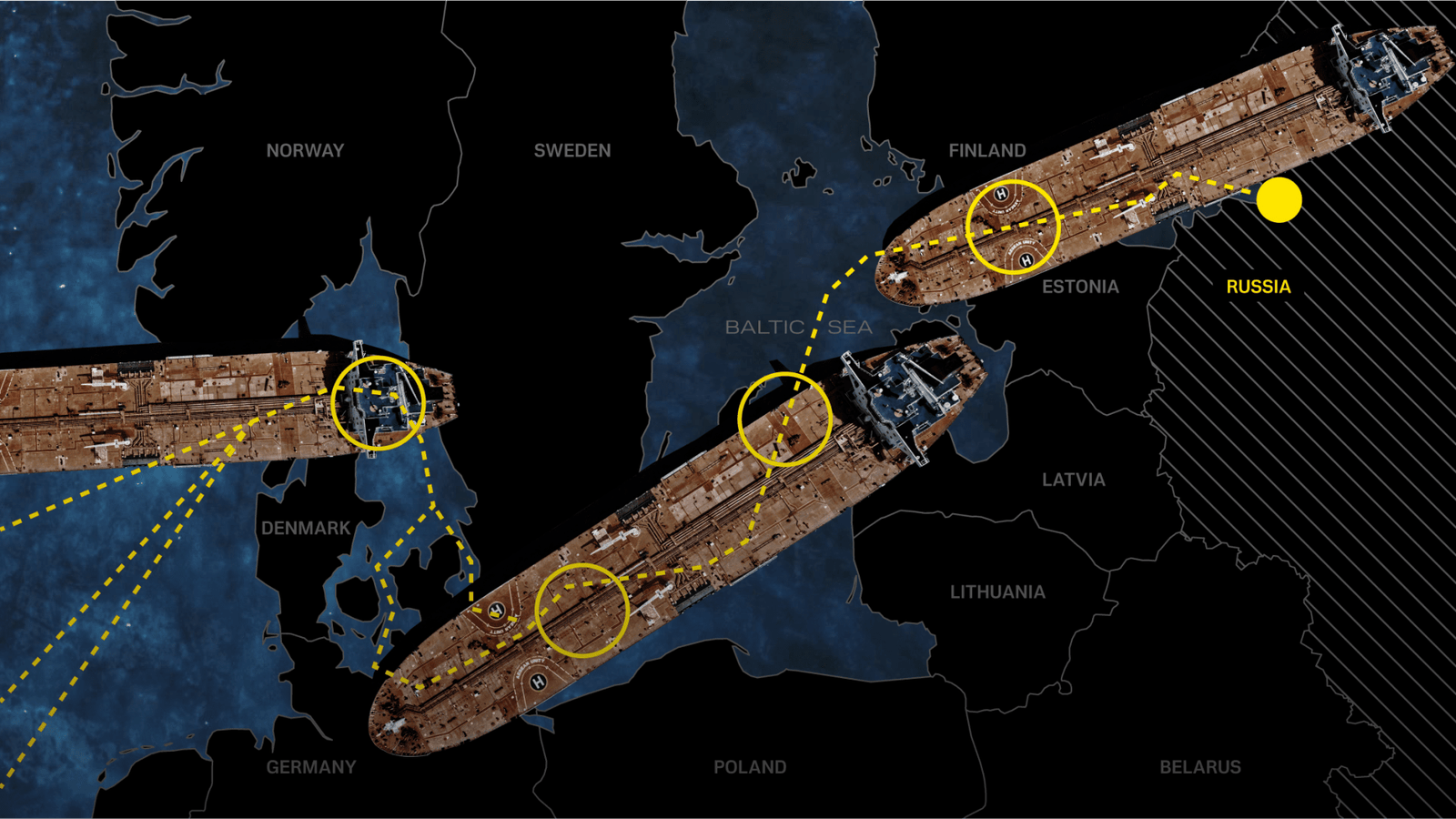
One of the defining operational characteristics of the shadow fleet is the widespread use of ship-to-ship (STS) transfers. Instead of transporting crude oil directly from Russian export terminals to final customers, cargoes are frequently transferred between tankers in international waters. During these operations, oil originating from Russian ports can be moved onto another vessel before continuing toward international markets. Although ship-to-ship transfers are a legitimate practice within global shipping under normal commercial circumstances, their extensive use in Russian oil exports has attracted growing scrutiny because it can complicate efforts to determine cargo origin and compliance with sanctions regimes.
Another important feature of the shadow fleet involves the management of vessel identification systems. International maritime regulations generally require commercial ships to operate Automatic Identification System (AIS) transponders that continuously transmit vessel location and navigational data. However, some vessels associated with sanctions-sensitive trade have periodically reduced the visibility of their movements by interrupting AIS transmissions during specific phases of voyages. While such interruptions may occur for various operational reasons, repeated patterns have raised concerns among maritime authorities regarding transparency, navigational safety, and sanctions monitoring.
Insurance has become another critical battlefield in the evolution of Russia’s maritime strategy. Prior to the introduction of Western sanctions, the overwhelming majority of internationally traded oil depended upon insurance provided by major European and international insurers. Restrictions targeting these services were intended to limit Russia’s ability to transport crude oil internationally. In response, alternative insurance arrangements gradually emerged, supported by domestic providers and non-Western commercial partners willing to facilitate continued trade. Although these alternatives do not always provide the same level of international recognition as traditional maritime insurers, they have nevertheless enabled a substantial portion of Russian energy exports to continue reaching international markets.
Financing mechanisms have undergone a similar transformation. Western sanctions significantly restricted access to major international banking systems, encouraging greater use of alternative payment arrangements, national currencies, and regional financial institutions. These adjustments have reduced dependence on traditional financial channels while strengthening commercial relationships with partners willing to continue purchasing Russian energy despite ongoing geopolitical tensions. As a result, sanctions have increasingly reshaped the geography of global energy trade rather than eliminating Russian exports altogether.
The commercial geography of Russian oil exports has changed profoundly since the introduction of Western restrictions. European markets, once among the largest destinations for Russian crude, have been largely replaced by expanding exports to Asian economies. China and India have emerged as major purchasers of Russian oil, taking advantage of discounted prices while helping sustain demand for Russian energy production. This shift has significantly altered global tanker routes, increasing voyage distances, reshaping freight markets, and creating new logistical patterns across the Indian Ocean and Asia-Pacific maritime corridors.
Longer shipping routes have also generated secondary economic consequences. Tankers transporting Russian crude now spend considerably more time at sea compared with pre-war trading patterns, reducing overall fleet availability and contributing to tighter conditions in global tanker markets. Freight rates have become increasingly sensitive to geopolitical developments, while demand for older vessels has risen as operators seek additional capacity outside traditional commercial fleets. Consequently, the shadow fleet has influenced not only Russian exports but also the broader economics of global maritime transport.
The growing reliance on ageing vessels has generated additional concerns regarding maritime safety and environmental protection. Many ships associated with sanctions-sensitive trade are considerably older than the average global tanker fleet, increasing the potential risks associated with mechanical failure, oil spills, or navigational accidents. Such incidents would have consequences extending well beyond commercial losses, particularly in environmentally sensitive regions including the Baltic Sea, the Black Sea, and heavily trafficked international shipping lanes. Environmental regulators therefore increasingly view the shadow fleet not merely as a sanctions issue but also as a potential ecological risk requiring enhanced international monitoring.
For European policymakers, the expansion of Russia’s shadow fleet has become inseparable from wider debates surrounding maritime security. Commercial vessels operating under opaque ownership structures now move through some of Europe’s most strategically sensitive waters, often in close proximity to critical undersea infrastructure including energy pipelines, electricity interconnectors, telecommunications cables, and offshore energy installations. Although commercial shipping itself remains an essential component of international trade, the reduced transparency surrounding certain vessel movements has prompted governments to strengthen maritime surveillance capabilities and improve coordination between civilian maritime authorities and national security institutions.
This evolution reflects a broader strategic reality. The shadow fleet is no longer simply a mechanism for transporting oil; it has become part of Russia’s wider effort to demonstrate economic resilience under conditions of sustained international pressure. By adapting commercial logistics, financial systems, insurance arrangements, and shipping practices, Moscow has shown that economic competition increasingly extends into areas once considered purely commercial. Maritime transport has become an arena of geopolitical contestation where logistics, finance, energy security, and strategic competition intersect.
Ultimately, the success of the shadow fleet should not be measured solely by the volume of oil transported. Its greater significance lies in what it reveals about the changing nature of international sanctions. The experience of recent years suggests that future economic coercion will increasingly resemble a contest of institutional adaptability rather than simple economic isolation. States capable of rapidly reorganizing trade networks, diversifying financial relationships, and developing alternative logistical systems may prove significantly more resilient than traditional sanctions models anticipated. For Europe and its partners, this represents an important strategic lesson: maintaining the credibility of sanctions in the twenty-first century will require not only financial restrictions but also far greater attention to the resilience, transparency, and governance of the global maritime system itself.