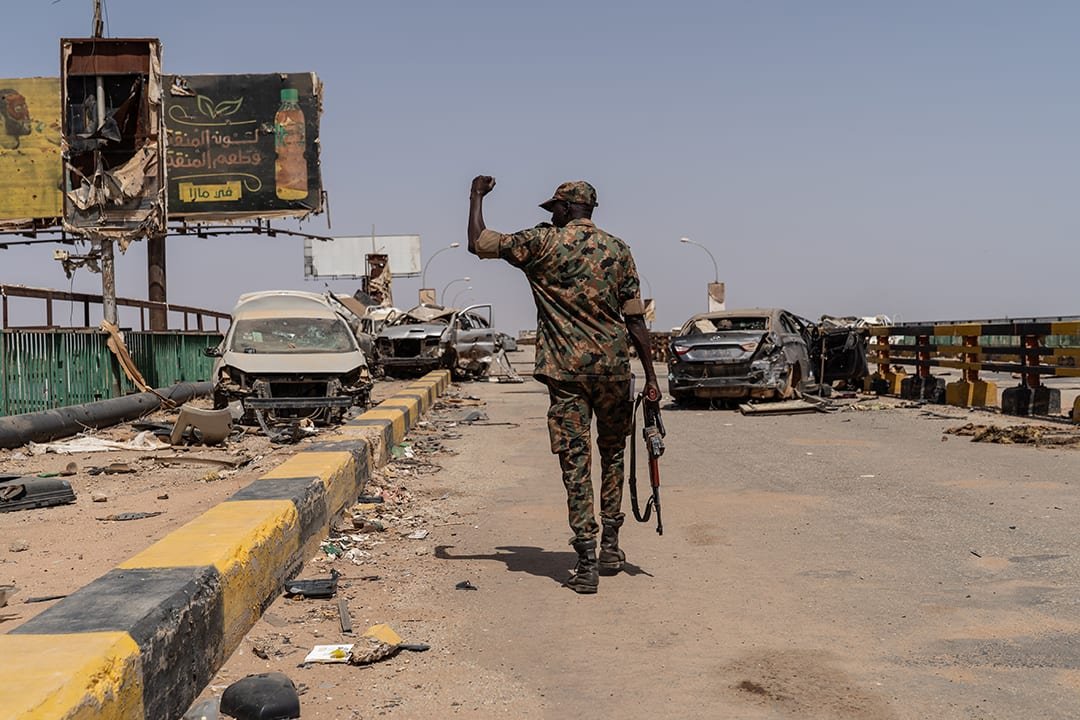
Since the outbreak of the Sudanese war on 15 April 2023, Saudi Arabia has presented itself as one of the region’s leading mediators seeking to end the conflict. Together with the United States, it hosted the Jeddah talks, which resulted in a declaration committing the parties to the protection of civilians and the facilitation of humanitarian assistance. Since then, Saudi Arabia’s official narrative has consistently emphasized the need for a ceasefire, a political settlement, and efforts to alleviate Sudan’s worsening humanitarian crisis.
However, the evidence documented in this investigation paints a markedly different picture of Saudi Arabia’s role. Beyond its publicly declared diplomatic efforts, the findings reveal an interconnected network of political, economic, logistical, and military activities that strengthened the position of the Sudanese Armed Forces (SAF), expanded their operational capabilities, and consolidated their authority throughout the conflict. This evolution raises growing political and legal questions regarding Saudi Arabia’s responsibility for supporting one of the principal parties to the war, at a time when humanitarian violations continue and prospects for a sustainable political settlement continue to diminish.
Drawing on an extensive analysis of international trade records, maritime shipping documents, flight-tracking data, corporate records, re-export routes, and financial transactions, this investigation reconstructs the network of relationships linking Riyadh to the military command centre in Port Sudan. It reveals how a multi-layered support structure emerged, extending well beyond conventional diplomatic engagement to encompass an integrated system of political, logistical, military, and economic assistance.
The investigation finds that this role extended far beyond official meetings and diplomatic initiatives. It included repeated executive flights, maritime supply routes, procurement networks for weapons, ammunition, and explosives, financial channels, and political and economic partnerships that collectively strengthened the Sudanese Armed Forces’ capacity to sustain military operations during one of Africa’s deadliest conflicts.
The evidence further demonstrates that these activities were neither isolated incidents nor coincidental developments. Instead, they formed interconnected components of a coordinated support architecture. From the air bridge linking Riyadh and Port Sudan, to maritime shipments of weapons and sensitive materials, commercial networks connected to Sudan’s Defence Industries System, and the rapidly expanding political relationship with General Abdel Fattah al-Burhan’s administration, the evidence reveals a consistent pattern of activities that reinforced the military and logistical infrastructure upon which the Sudanese Armed Forces relied throughout the war.
Rather than examining flights, vessels, and commercial shipments in isolation, this investigation places them within a single chronological framework, illustrating how political, economic, logistical, and military instruments converged to form an integrated support network that enhanced the operational resilience of the Port Sudan authorities, while Saudi Arabia simultaneously maintained its public image as a mediator leading international efforts to end the conflict.
Ultimately, the investigation concludes that the documented evidence reveals far more than a conventional political relationship between two states. It points instead to a multi-layered support network that strengthened the political, military, logistical, and economic capabilities of the Sudanese Armed Forces and allied armed groups, including the Al-Baraa bin Malik Brigade, which has been designated by the United States as a Foreign Terrorist Organization, thereby reinforcing the authority of the Port Sudan administration and expanding its ability to sustain military operations throughout the conflict.
Flights Between Riyadh and Port Sudan: An Air Bridge Operating Beyond Public Scrutiny
Flight-tracking data reveals a series of non-commercial executive flights directly linking Riyadh with Port Sudan, the de facto seat of the authority led by the Sudanese Armed Forces and allied militias, including the Al-Baraa bin Malik Brigade, which has been designated as a terrorist organization. These flights do not operate as part of regular civilian air services; instead, they are carried out by private aircraft typically used to transport senior officials, government delegations, funds, documents, and sensitive equipment.
In December, a Gulfstream G550, bearing the Saudi registration HZ-SK5, operated a direct flight from Riyadh to Port Sudan. The aircraft is operated by Alpha Star Aviation Services and Sky Prime Aviation, two Saudi companies specializing in executive aviation and private flight operations.
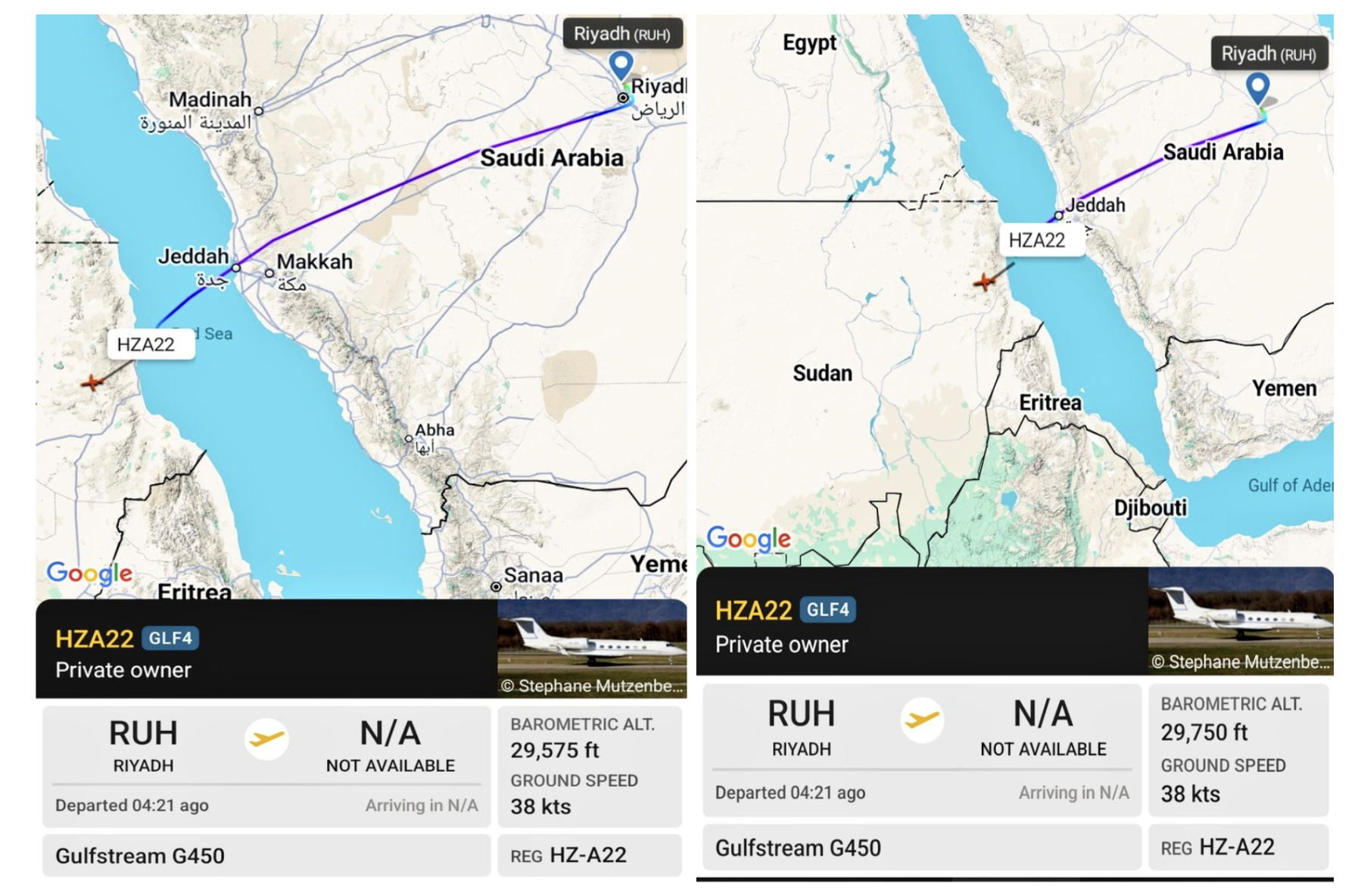
Flight-tracking data showing Saudi-registered Gulfstream G450 (HZ-A22) operating a direct executive flight between Riyadh and Port Sudan.
The significance of this flight extends well beyond routine aviation activity. It flew directly to the centre of Sudan’s military authority at a time when Saudi Arabia was expanding its political and security ties with the leadership of the Sudanese Armed Forces. Moreover, the type of aircraft employed is particularly suited for rapid, flexible missions outside regular commercial aviation networks, allowing the transport of high-level passengers and sensitive cargo with a lower degree of public visibility.
Less than two weeks later, a Mitsubishi CRJ-200LR operated by Badr Airlines, bearing the registration ST-BAT, flew from Port Sudan to Riyadh. This aircraft has previously been used to transport senior officials affiliated with the Sudanese authorities, reinforcing the assessment that these reciprocal flights formed part of an established communication channel linking Riyadh with the Sudanese military leadership.
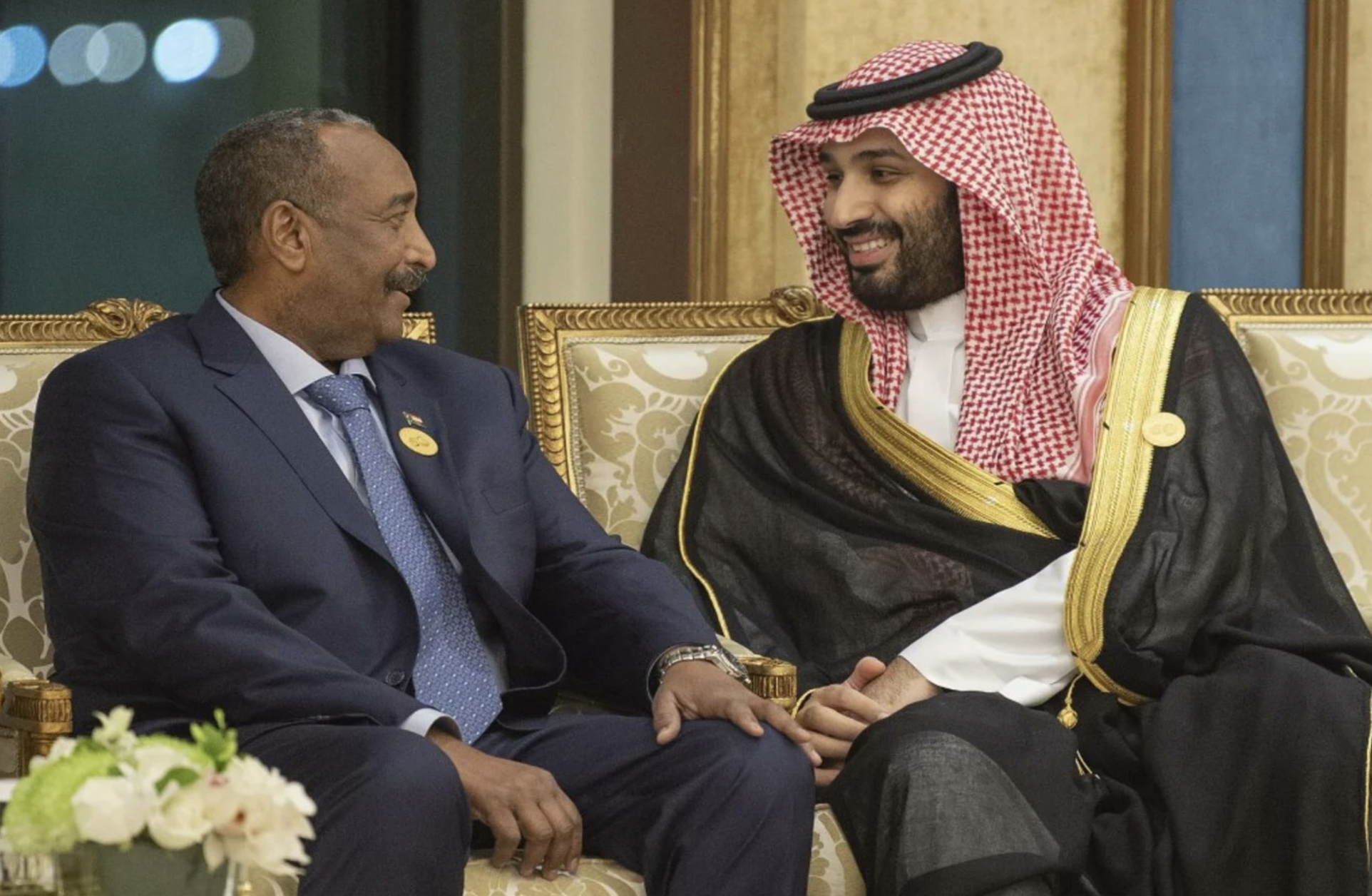
Saudi Crown Prince Mohammed bin Salman meets Sudanese Armed Forces leader General Abdel Fattah al-Burhan in Jeddah, as political and security cooperation between Riyadh and Port Sudan deepened.
On the morning of 7 January, a Gulfstream G450, operated by Alpha Star Aviation and bearing the Saudi registration HZ-A22, flew directly from Riyadh to Port Sudan.
According to aviation-tracking specialists, this type of aircraft is commonly used to transport high-level officials, financial assets, sensitive documents, and other cargo requiring a high degree of operational flexibility and confidentiality.
This flight cannot be viewed in isolation from its broader political and financial context. It took place at a time when Saudi Arabia was actively expanding its ties with the Port Sudan authorities while increasing its political and financial support for them, making it part of a sustained air bridge rather than an isolated diplomatic or protocol mission.
On 14 February, a Cessna 680A Citation Latitude, also operated by Alpha Star Aviation and bearing the registration HZ-A26, carried out another direct flight from Riyadh to Port Sudan. The flight took place just one day after Intelligence Online published a report alleging the transfer of Saudi-supplied artillery systems to the Sudanese Armed Forces.
The timing of this flight, coinciding with reports of Saudi military shipments, places it within a broader pattern of movements that supported the Sudanese Armed Forces and reinforced their operational military capabilities, while also benefiting allied armed formations operating alongside the army.
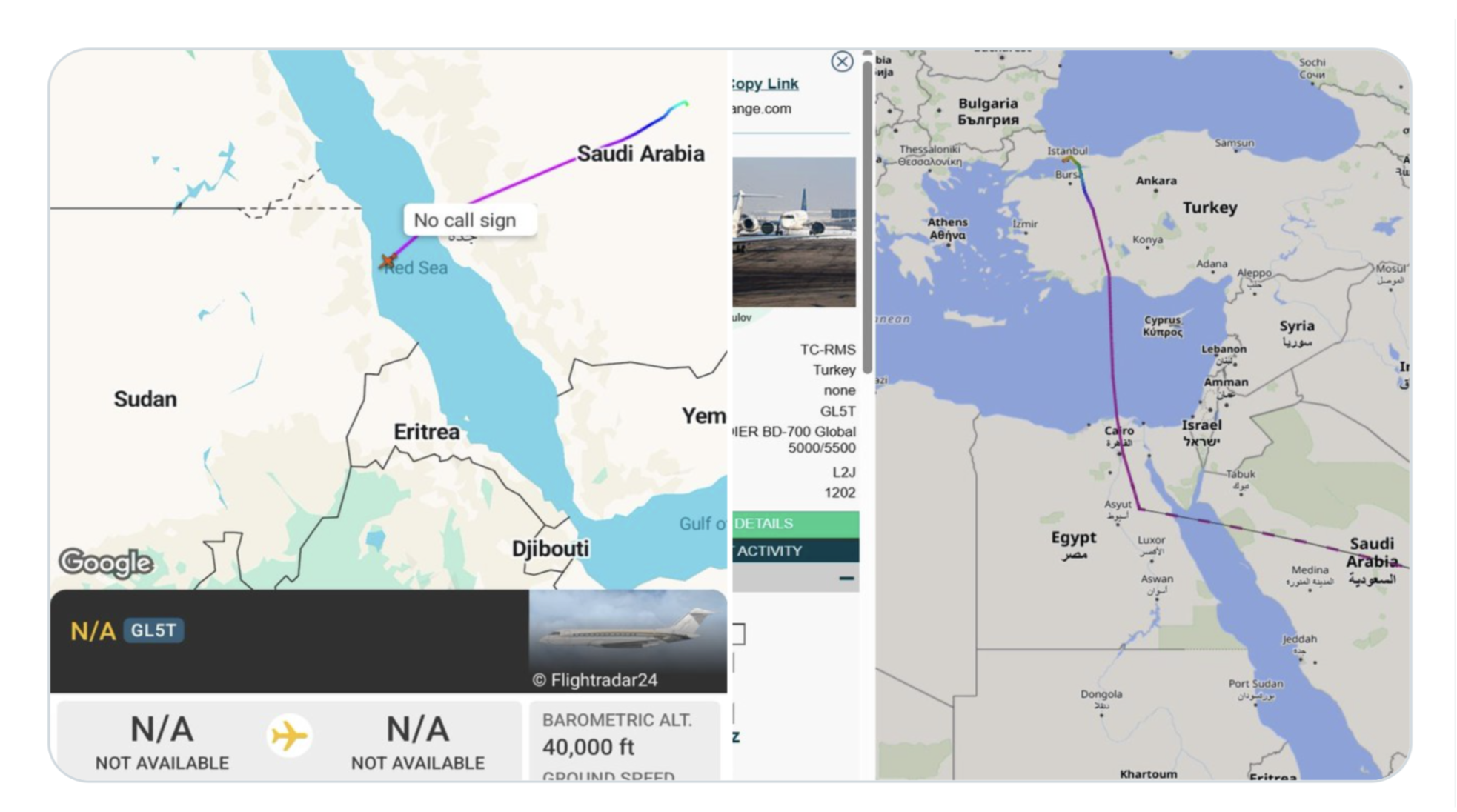
On 22 June, a Bombardier Global 5000, bearing the registration TC-RMS and operated by Bonair Havacılık, departed Riyadh for Khartoum after arriving in Saudi Arabia from Istanbul on 20 June.
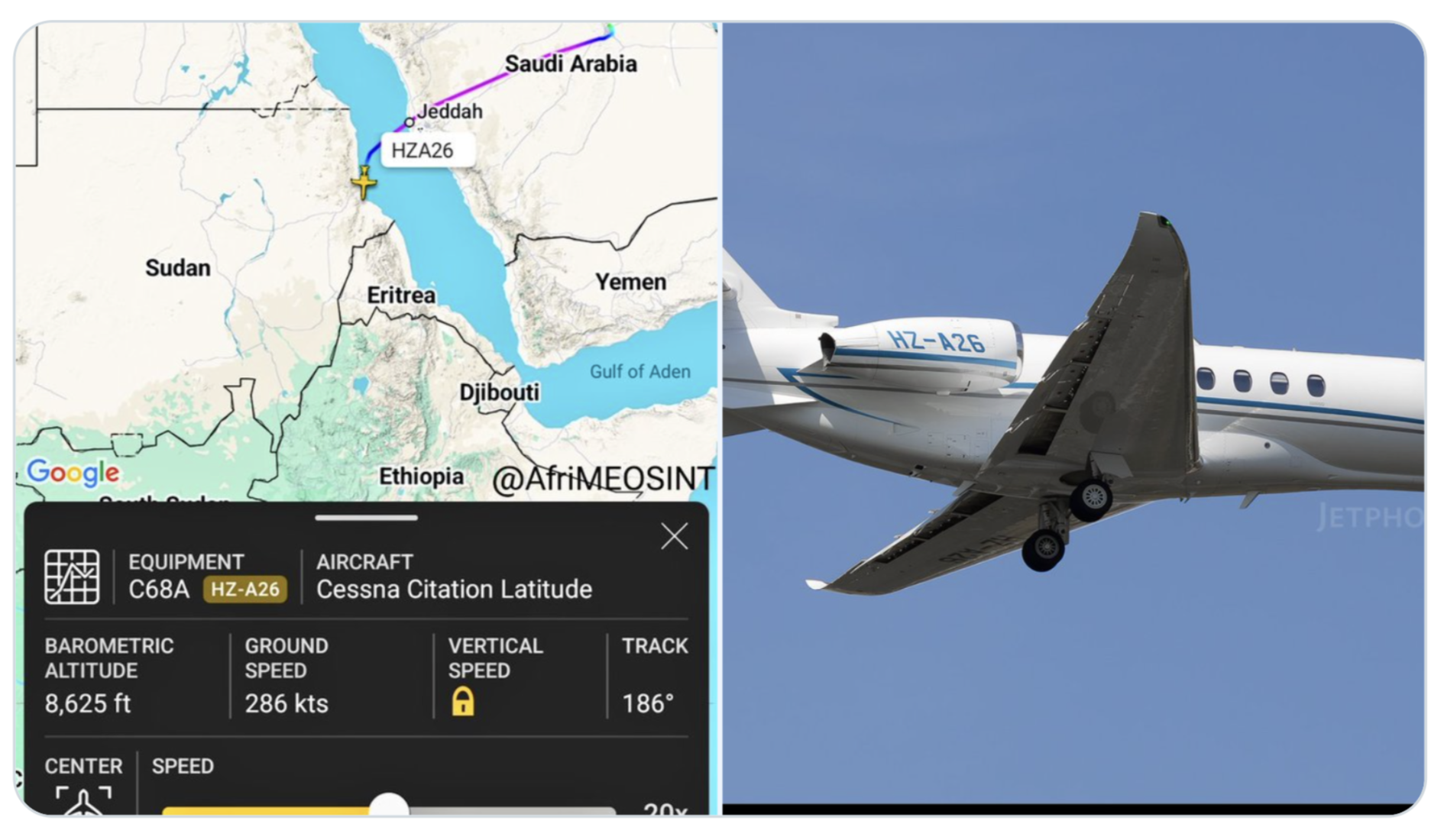
Flight-tracking records and aircraft imagery of Saudi-registered Cessna Citation Latitude (HZ-A26), documenting another executive flight linking Riyadh and Port Sudan.
This flight was not an isolated event. Rather, it formed part of a recurring pattern of executive flights linking Saudi Arabia with territories under the control of the Sudanese Armed Forces and allied armed groups. The frequency of these flights, when viewed alongside reports of military transfers, financial support, and high-level political engagement, suggests that Riyadh maintained a continuous air corridor with the Burhan-led authorities.
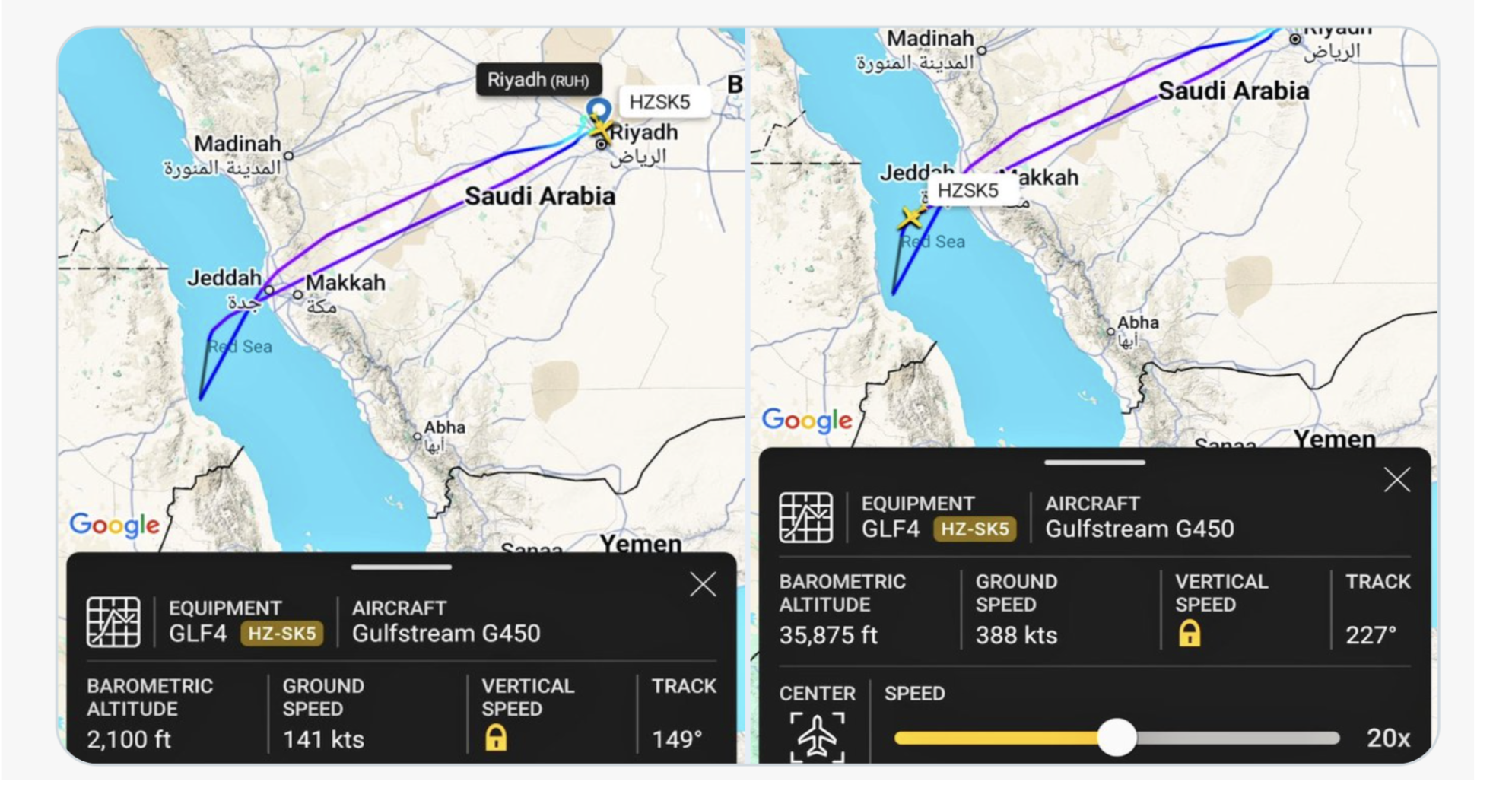
The Saudi-registered aircraft HZ-SK5 was subsequently tracked operating another direct flight from Riyadh to Port Sudan before returning to the Saudi capital less than four hours later. The aircraft’s exceptionally short stay in Sudan indicates that this was not a routine commercial or operational flight, but rather a rapid mission with a clearly defined purpose.
Flight-tracking data showing the Saudi-registered Gulfstream G550 (HZ-SK5) operating a direct round-trip flight between Riyadh and Port Sudan, with a ground stop of less than four hours.
The repeated use of the same aircraft, particularly at moments coinciding with the expansion of Saudi Arabia’s political, military, and financial support, gives these flights significance that extends well beyond routine diplomatic travel. Rather, they point to a sustained air bridge facilitating the movement of senior officials, financial resources, technical support, and other sensitive assets to Sudan’s military authorities.
Taken together, the available evidence indicates that Saudi Arabia maintained a direct and continuous channel of engagement with the Port Sudan authorities, providing forms of support that extended beyond diplomatic mediation while carrying out logistical operations that reinforced the authorities’ capacity to sustain military operations throughout the conflict.
M777 Artillery: Saudi Support Shifts from Political Cover to Direct Military Assistance
Up to this point, the repeated executive flights between Riyadh and Port Sudan had pointed to the existence of an open political and logistical channel between Saudi Arabia and the Sudanese Armed Forces. On 13 February 2026, however, new evidence indicated that this support had moved to a more consequential level.
Intelligence Online reported that Saudi Arabia had transferred three batteries of M777 155mm howitzers to the Sudanese Armed Forces, together with substantial quantities of compatible ammunition. The report was based on documents, photographs, and video material reviewed by its investigative team, which showed the artillery systems in use inside Sudan. It also cited intelligence sources stating that Sudanese artillery personnel had received training in their operation.
The support was not limited to the transfer of artillery systems. According to the information reviewed, Saudi Arabia also backed training programmes for the personnel assigned to operate the weapons. These programmes covered system operation, fire control, and safety procedures, enabling the artillery to be integrated into the Sudanese Armed Forces’ operational structure.
From this perspective, the recurring flights between Riyadh and Port Sudan can no longer be viewed merely as diplomatic movements or political communication channels. Rather, they formed part of a broader support architecture designed to provide direct military assistance to the Sudanese Armed Forces.
According to information published by Intelligence Online, citing security sources, the M777 systems and their ammunition entered Sudan through the Port of Port Sudan, the principal maritime gateway under the control of the Sudanese Armed Forces. The sources said the port was selected to facilitate the unloading, temporary storage, and onward distribution of the weapons to active fronts, while reducing the risk of interception or attack.
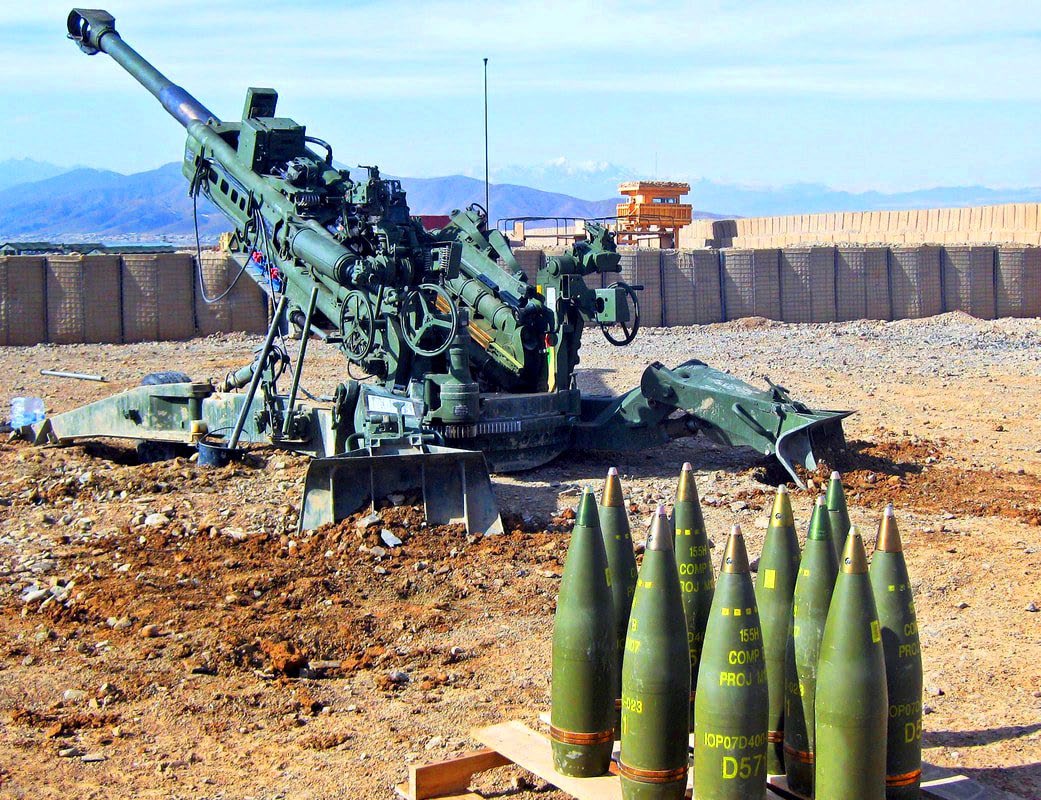
M777 155mm howitzers, which Intelligence Online reported were transferred to the Sudanese Armed Forces together with compatible ammunition and training.
The available information further indicates that the logistical coordination of the operation was conducted through channels linked to Saudi military intelligence, in coordination with their counterparts within the Sudanese Armed Forces. According to the reported information, these arrangements were designed to preserve the confidentiality of the supply chain, reduce the likelihood that the shipments could be traced or officially attributed to Riyadh, and ensure their delivery to the intended military units.
The M777 is among the world’s most advanced towed field artillery systems. Developed in the United States and manufactured by BAE Systems, it gained international prominence following its extensive deployment during the war in Ukraine. Saudi Arabia operates more than one hundred M777 howitzers, making the reported transfer of three complete artillery batteries to Sudan a significant indicator of a qualitative shift in the nature of the support provided.
Viewed in this context, the reported shipment cannot be regarded as an isolated arms transfer. Rather, it forms part of a broader pattern through which Saudi Arabia supported the military capabilities of the Sudanese Armed Forces by providing advanced weapons systems, ammunition, and specialized training, thereby enhancing their capacity to sustain military operations.
Among the principal beneficiaries of these military arrangements is the Al-Baraa bin Malik Brigade, which emerged during the Sudanese conflict as one of the most prominent armed formations fighting alongside the Sudanese Armed Forces across multiple fronts. On 16 March 2026, the United States designated the Al-Baraa bin Malik Brigade as a Foreign Terrorist Organization (FTO), citing its involvement in acts of violence against civilians, summary executions, efforts to undermine political settlement initiatives, and the reported training and support received by some of its members from Iran’s Islamic Revolutionary Guard Corps (IRGC), according to the U.S. Department of State.
Against this backdrop, the continued political, financial, logistical, and military support provided to the Sudanese Armed Forces inevitably strengthens the operational capabilities of the military structures with which they conduct joint operations, including allied armed groups such as the Al-Baraa bin Malik Brigade, now designated by the United States as a Foreign Terrorist Organization.
Taken together, the available evidence suggests that Saudi Arabia’s role has extended well beyond political or diplomatic backing. Instead, it points to an integrated framework of military and logistical assistance that reinforced the firepower and operational capacity of the Sudanese Armed Forces while simultaneously strengthening the military structures fighting alongside them, including U.S.-designated terrorist formations, thereby expanding their ability to sustain the conflict despite its escalating humanitarian consequences.
The Maritime Route Through Saudi Arabia: How Riyadh Facilitated the Transfer of Sensitive Materials into Sudan’s Military Supply Network
Support for the Port Sudan authorities was not limited to executive flights and arms transfers. It also extended to maritime supply routes, through which Saudi Arabia served as a logistical transit corridor for sensitive materials that ultimately entered supply networks linked to the Sudanese Armed Forces.
International trade records and shipping data reviewed by this investigation show that, in mid-2024, the Sudanese company Ports Engineering Company imported seventeen chlorine gas cylinders from the Indian supplier Chemtrade International Corp. Rather than being shipped directly to Sudan, the consignment transited through Saudi Arabia before arriving at the Port of Port Sudan, the country’s principal maritime gateway under the control of the Sudanese Armed Forces, from where it was subsequently distributed inland.
The significance of this shipment lies not only in the nature of the chemical substance involved, but also in the identity of the recipient. Ports Engineering Company is not an independent commercial enterprise. Instead, it operates within the economic and logistical network associated with Sudan’s military establishment and is headed by a serving officer in the Sudanese Armed Forces, making it an integral component of the military’s procurement, storage, and distribution infrastructure.
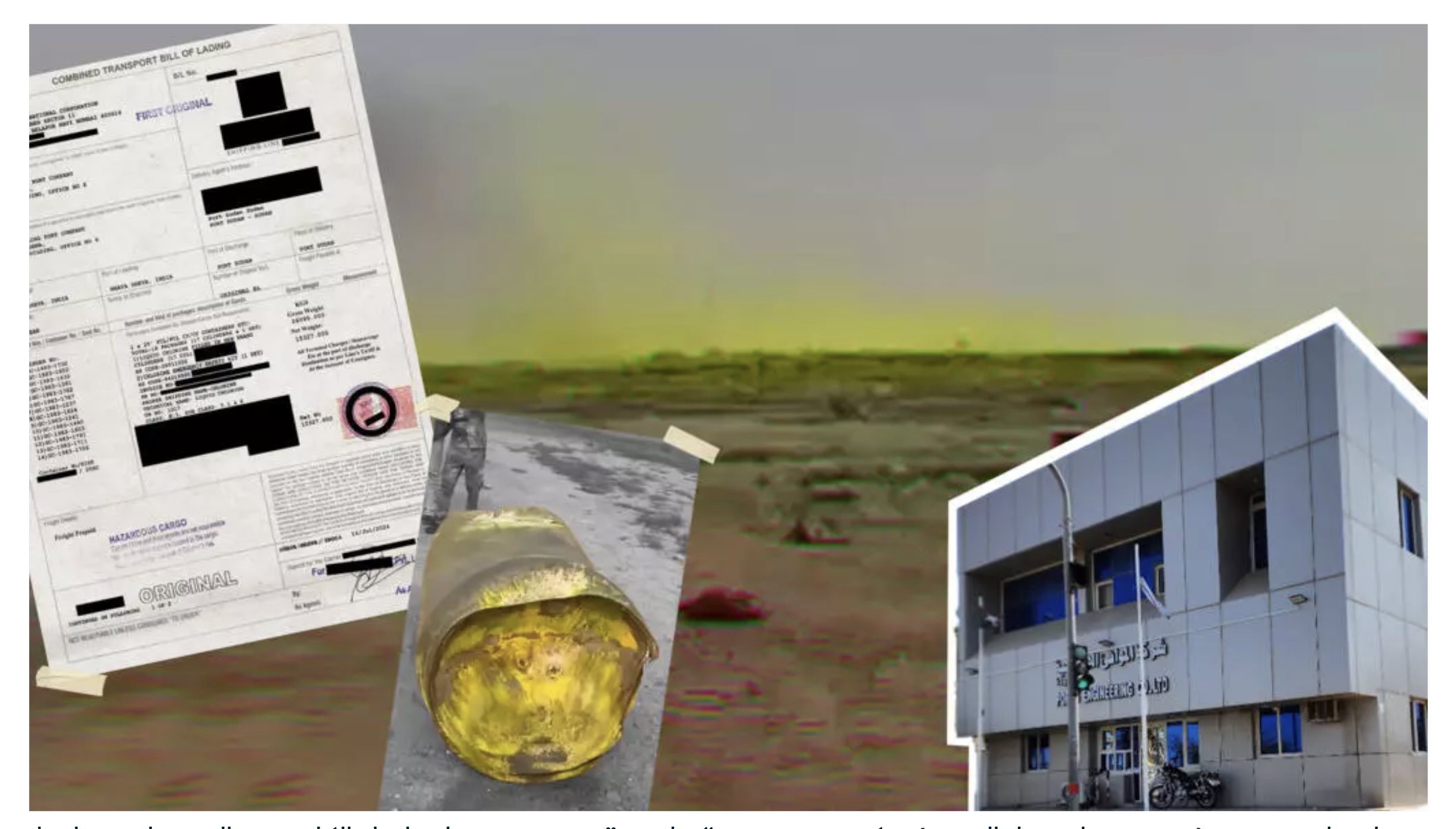
Transport records indicate that Saudi Arabia served as a key transit hub within the supply chain that delivered these materials to Sudan. While the shipment’s passage through Saudi ports does not, in itself, establish that the Saudi authorities were aware of its ultimate end use, it does demonstrate that Saudi Arabia functioned as a logistical corridor within a transportation network that ultimately delivered the consignment to a company directly linked to Sudan’s military establishment.
Once the shipment reached the Port of Port Sudan, it entered the transportation and distribution network controlled by the Sudanese Armed Forces. According to the evidence reviewed, the consignment was unloaded, stored, and redistributed through military-controlled logistical channels to multiple locations across the country, beyond any independent oversight of its final destination or eventual use.
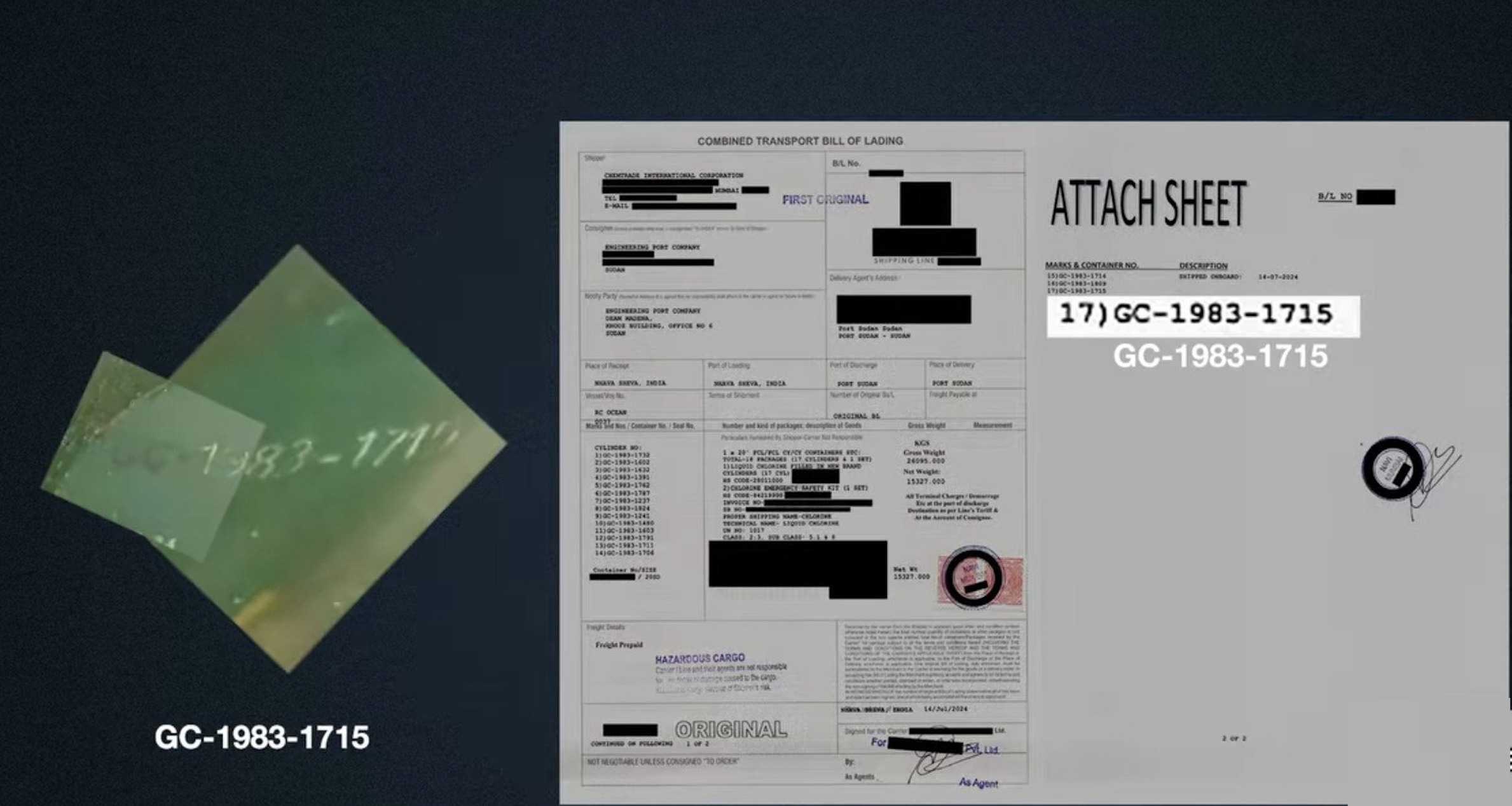
Shipping and transport records showing the route of the chlorine shipment from India through Jeddah Islamic Port before its arrival at Port Sudan, illustrating Saudi Arabia’s role as a logistical transit hub within the supply chain.
The same chlorine cylinders later reappeared inside Sudan, where the Sudanese Armed Forces allegedly used them in a chemical attack in the Al-Jaili Refinery area, a location that witnessed intense military operations. Their appearance on the battlefield renewed questions about how these materials reached Sudan, the entities that ultimately received them, and the role they played during military operations.
As evidence relating to the alleged use of chlorine in military operations continued to emerge, investigators and independent experts retraced the shipment’s journey from its departure in India to its arrival in Sudan. Their objective was to reconstruct the supply chain, identify the actors involved in facilitating its transit through Jeddah Port in Saudi Arabia, and understand the logistical routes that enabled the shipment to reach entities linked to the Sudanese Armed Forces.
This incident does not stand in isolation from the broader body of evidence presented in this investigation. When examined alongside the executive flights, the reported transfers of M777 artillery systems, and the documented financial transactions, it forms part of a broader pattern indicating a coordinated support network. Taken together, the available evidence suggests that Saudi Arabia provided political backing, reinforced logistical infrastructure, and facilitated transportation routes that strengthened the operational capabilities of the military authorities in Port Sudan while helping sustain their military supply network throughout the conflict.
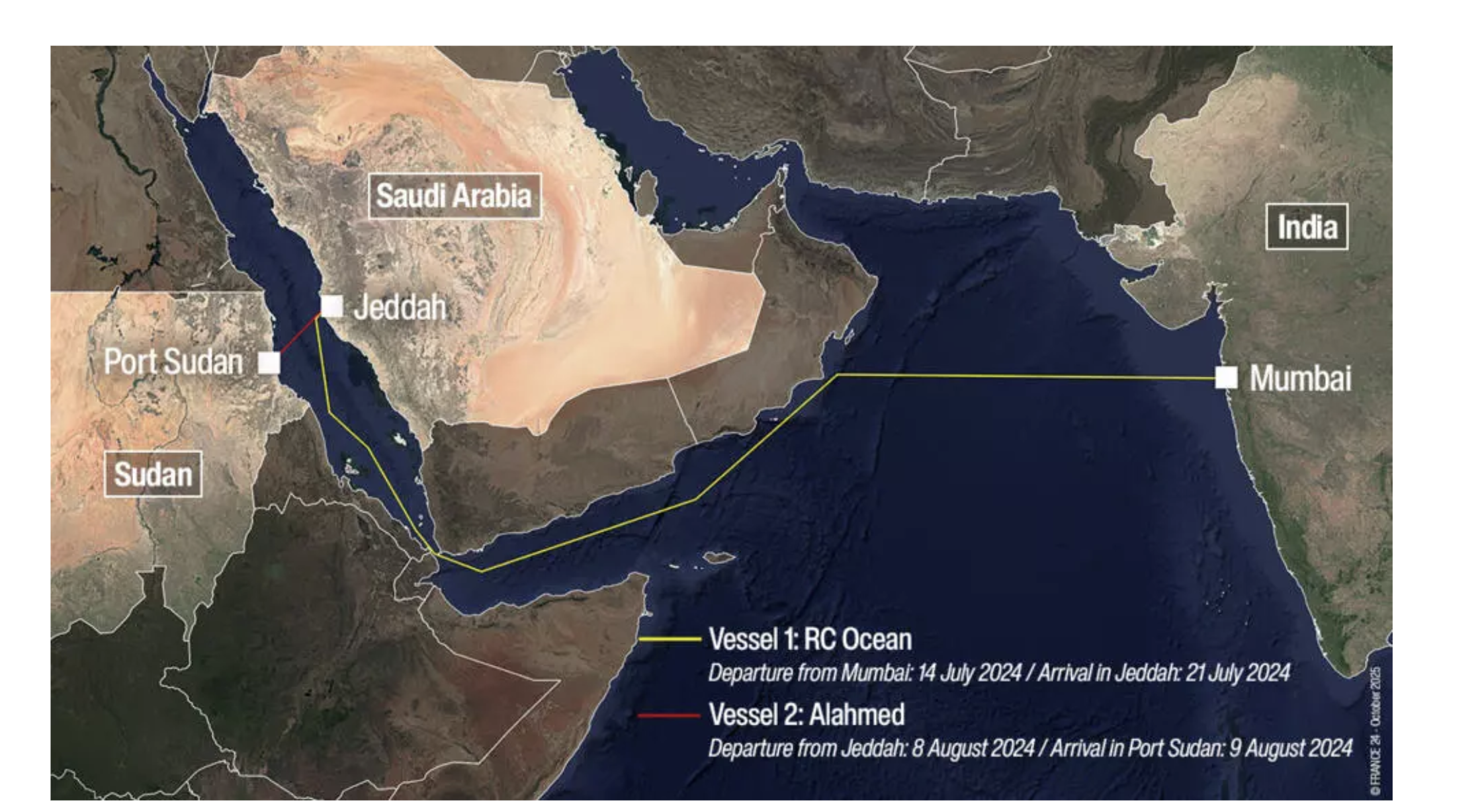
Shipping and transport records showing the route of the chlorine shipment from India through Jeddah Islamic Port before its arrival at Port Sudan, illustrating Saudi Arabia’s role as a logistical transit hub within the supply chain.
Explosives Supply Network: A Procurement System That Strengthened the Sudanese Armed Forces’ Military Capabilities
The indicators of support documented in this investigation extend far beyond executive flights and reported artillery transfers. They also encompass one of the most sensitive components of the military supply chain: the procurement network for explosives and materials used in the manufacture of ammunition and explosive devices. An analysis of international trade records and shipping documentation shows that this network did not operate on an ad hoc basis or rely on a single supplier. Instead, it functioned through an integrated procurement system that operated over several years and supplied companies directly linked to Sudan’s Defence Industries System (DIS), the industrial and military arm of the Sudanese Armed Forces.
The available records indicate that Target Multiactivities Company (TMAC) operates within the network of companies controlled by Sudan’s Defence Industries System through the GIAD Industrial Group. This places the company within the military and economic infrastructure upon which the Sudanese Armed Forces rely to secure materials used in the production of ammunition and explosives. According to the records reviewed in this investigation, TMAC functioned not merely as a commercial importer, but as one of the entities supporting the military establishment’s procurement and supply chain.

Target Multiactivities Company (TMAC) as part of the Sudan Defence Industries System (DIS) through the GIAD Industrial Group, linking the company to Sudan’s military-industrial procurement network.
Trade records show that the Indian company SBL Energy Limited became the principal supplier to this procurement network from 2024 onward, carrying out more than 200 shipments of explosives and related materials for TMAC. International trade databases further indicate that the company was responsible for 314 of the 477 recorded shipments destined for the Sudanese company. The scale and continuity of these transactions point to a stable and sustained commercial relationship that ensured a regular flow of materials used in military production, thereby reinforcing the ability of companies linked to the Sudanese Armed Forces to maintain their production lines and sustain supplies throughout the conflict.
The supply network, however, extended well beyond a single supplier. Trade records document an additional 147 shipments carried out by IDL Explosives Ltd., eight shipments by Ashoka Manufacturing Ltd., and two shipments by CDET Explosive Industries Ltd.. The diversity of suppliers demonstrates that the procurement system did not rely on a single supply channel but instead operated through a multi-source network designed to ensure the uninterrupted delivery of explosives and related materials, even if one supply route was disrupted.
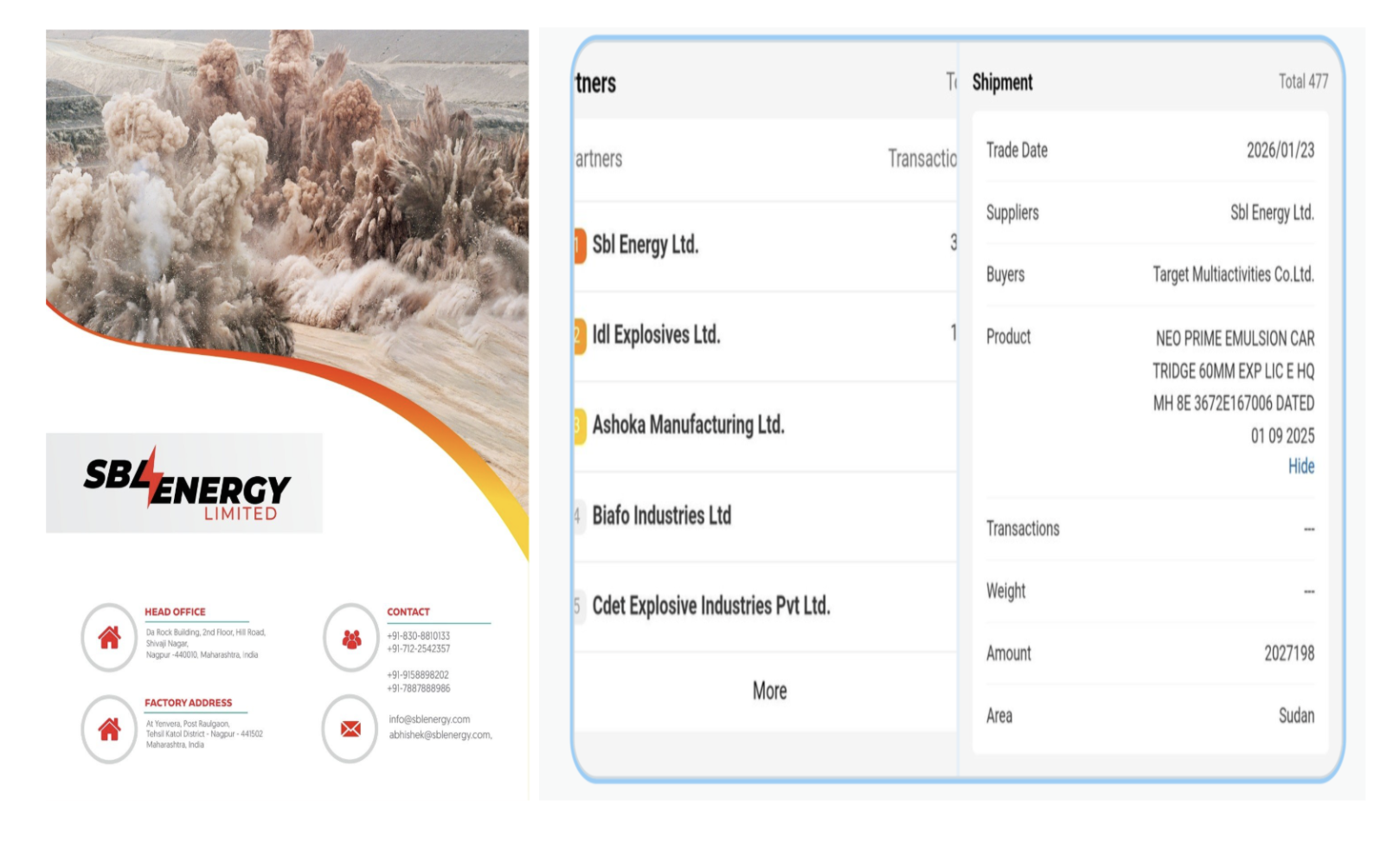
International trade records documenting multiple suppliers of explosives and related materials to TMAC, illustrating a diversified procurement network supporting Sudan’s military-industrial infrastructure.
On 23 January 2026, TMAC imported another shipment of explosive materials classified under HS Code 36020010, including Neo Gel 901 and Neo Prime products in various sizes. The shipment was transported along a maritime route from the Port of Kochi, India, to Port Sudan.
However, the shipping records reveal that these materials did not reach Sudan through a direct route. Instead, they transited through Jeddah Islamic Port in Saudi Arabia before continuing across the Red Sea to Port Sudan, where they entered the network of companies operating under Sudan’s Defence Industries System.
The logistics data indicate that the transit through Jeddah was an integral component of the supply chain that ultimately delivered the shipment to entities linked to Sudan’s military-industrial infrastructure, highlighting the strategic role of the Saudi maritime corridor in facilitating the movement of these materials.
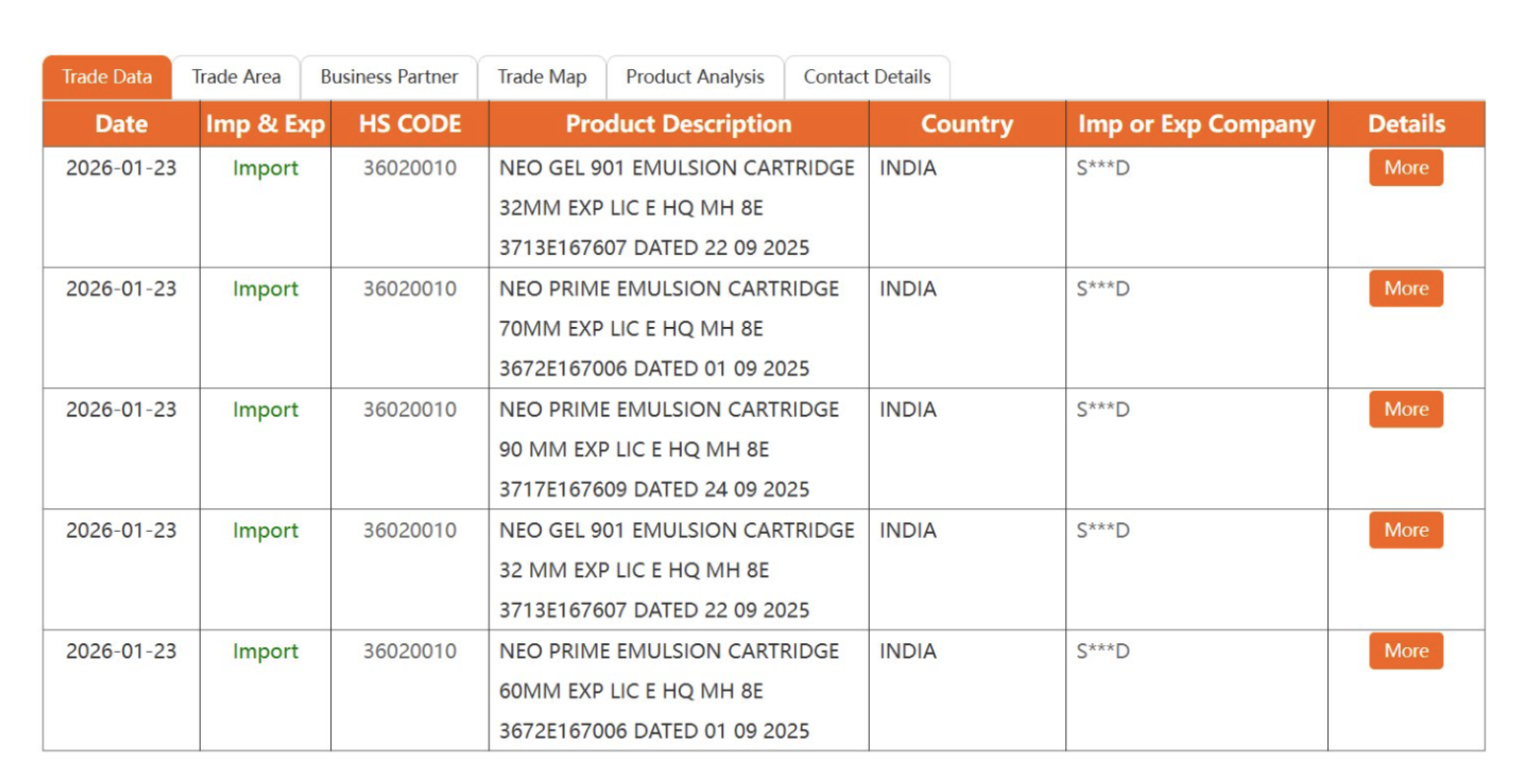
Trade and shipping records documenting the transit of explosive materials before their redistribution within Sudan’s military supply network.
The transit of these materials through Jeddah before their arrival in Port Sudan points to the existence of a regional supply chain that ensured the continued flow of highly sensitive materials to companies linked to Sudan’s military establishment.
Once the shipments arrived in Port Sudan, they entered the transportation and storage network controlled by the Sudanese Armed Forces. From there, they were redistributed to companies and facilities operating under Sudan’s Defence Industries System, enabling the continued production of military materiel and ammunition at a time when combat operations were expanding across multiple fronts.
Taken together, the evidence suggests that these developments were not isolated incidents but components of a broader support architecture that relied on interconnected air, maritime, and commercial channels. This network contributed to strengthening the logistical and military capabilities of the Sudanese Armed Forces and the military structures operating alongside them, including allied armed formations such as the Al-Baraa bin Malik Brigade, which has been designated by the United States as a Foreign Terrorist Organization (FTO).
The findings further demonstrate that the supply chain extended well beyond conventional weapons transfers. It also encompassed the raw materials essential to sustaining military production, thereby reinforcing the capacity of Sudan’s military-industrial infrastructure to continue manufacturing ammunition and other military materiel throughout the conflict. In doing so, these procurement networks assumed a strategic role that went far beyond ordinary commercial trade, becoming an integral component of the military sustainment system supporting the war effort.
From Mediation to Partnership: How Saudi Arabia Became One of the Principal Supporters of the Port Sudan Authorities
The evidence assembled in this investigation indicates that the relationship between Saudi Arabia and the administration led by General Abdel Fattah al-Burhan has evolved well beyond diplomatic contacts and publicly declared mediation efforts. Instead, it developed into an expanding political, economic, and security partnership, accompanied by a significant increase in logistical and military support during one of the deadliest phases of Sudan’s civil war.
On 20 April 2026, Saudi Crown Prince Mohammed bin Salman received General Abdel Fattah al-Burhan, Chairman of Sudan’s Transitional Sovereignty Council, in Jeddah. The meeting took place as intelligence reports were pointing to arrangements for a US$1.5 billion Pakistani arms package intended for the Sudanese Armed Forces, amid reports that Saudi Arabia was considering financial backing or support for the deal.
The meeting was far more than a routine diplomatic engagement. Rather, it formed part of a broader series of political initiatives that strengthened the regional standing of the Port Sudan authorities and consolidated Saudi Arabia’s position as their most influential external partner during the new phase of military rule.
Only weeks later, both governments announced preparations for launching a Saudi–Sudanese Strategic Cooperation Council, marking a clear transition from diplomatic mediation to a long-term institutional partnership. The relationship was no longer centred on managing Sudan’s political crisis but on establishing a permanent framework for political, economic, and security coordination between the two governments.
This development coincided with the Port Sudan authorities granting Saudi companies preferential access to future reconstruction projects, infrastructure, ports, energy, agriculture, and transportation sectors. These decisions indicate that Riyadh’s political support was closely intertwined with long-term strategic and economic interests aimed at shaping Sudan’s post-war political and economic landscape.
The evidence documented in this investigation further demonstrates that this growing partnership was not built solely through high-level political meetings. It was accompanied by repeated executive flights, maritime supply routes, arms transfers, commercial procurement networks, and sustained high-level contacts that collectively reinforced and supported the Sudanese Armed Forces and the allied armed formations fighting alongside them, while consolidating their military position throughout the conflict.
Ultimately, the evidence points to far more than a conventional mediation effort. It reveals a strategic transformation in Saudi Arabia’s role in Sudan. Through an interconnected network of political, economic, logistical, and military instruments, Riyadh strengthened the position of the Port Sudan authorities, enhanced their capacity to sustain military operations, and established itself as one of the most influential external actors shaping the course of the conflict.
Given the Sudanese Armed Forces’ reliance on allied armed formations—including the Al-Baraa bin Malik Brigade, which the United States designated as a Foreign Terrorist Organization (FTO)—these findings raise significant political and legal questions regarding the responsibilities of states that provide political, financial, logistical, or military support to parties engaged in an armed conflict. They also underscore the broader humanitarian and regional security implications of such support for Sudan’s future and the wider Horn of Africa.