The European Centre for Strategic Studies and Policy (ECSAP)
The resignation of British Defence Secretary John Healey and Armed Forces Minister Al Carns has exposed a deeper crisis at the heart of European security: the widening gap between strategic ambitions and political willingness to fund them.
While European governments increasingly acknowledge that the continent faces its most dangerous security environment since the Cold War, many continue to struggle with the economic, political, and institutional challenges associated with sustained rearmament. The United Kingdom, traditionally one of Europe’s leading military powers, now finds itself at the center of this debate.
The departure of two senior defence officials over disagreements regarding defence spending raises fundamental questions about Britain’s ability to maintain military readiness, fulfill NATO commitments, and respond to emerging threats. More importantly, it highlights a broader European problem. Across the continent, governments recognize the need for greater military investment but remain constrained by fiscal pressures, domestic political priorities, and uncertainty regarding future American security guarantees.
This paper argues that Europe is entering a decisive period in which defence investment will increasingly determine geopolitical relevance. Failure to address structural weaknesses in defence funding risks undermining deterrence, weakening NATO’s European pillar, and encouraging strategic opportunism from adversaries.
The war in Ukraine fundamentally transformed European security thinking. For decades, many European governments benefited from a post-Cold War peace dividend, reducing defence spending while relying heavily on American military power to guarantee continental security.
That era has ended.
Russia’s invasion of Ukraine, persistent instability in the Middle East, growing cyber threats, and increasing strategic competition between major powers have forced European governments to reconsider long-held assumptions regarding defence and security.
Yet acknowledging threats is not the same as addressing them.
The political controversy surrounding Britain’s Defence Investment Plan demonstrates how difficult it remains for democratic governments to translate strategic awareness into concrete military spending. The resignations of senior British defence officials reveal growing frustration within defence establishments that political leaders recognize the threat environment but remain reluctant to allocate the resources required to address it.
The implications extend far beyond the United Kingdom.
Britain’s Defence Funding Dilemma
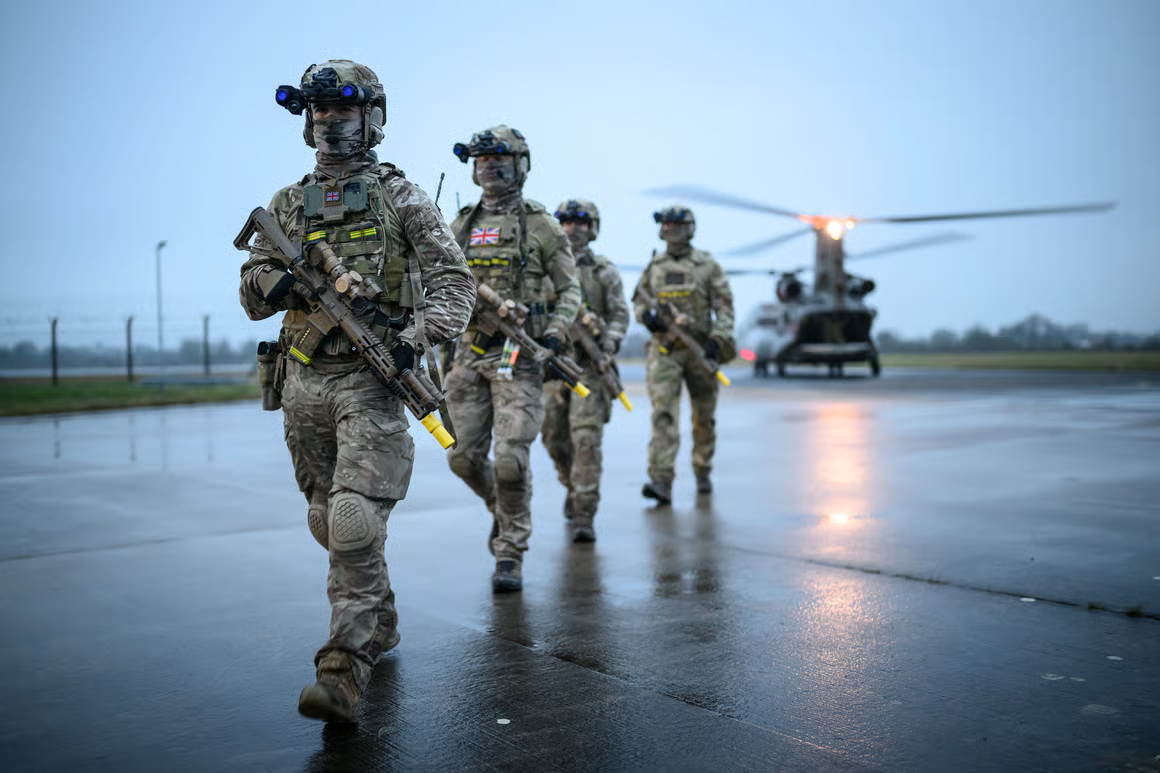
The United Kingdom remains one of Europe’s most capable military powers. It possesses nuclear weapons, advanced intelligence capabilities, global military reach, and one of NATO’s most experienced armed forces.
However, maintaining these capabilities has become increasingly expensive.
Years of inflation, rising procurement costs, personnel shortages, and growing operational demands have placed significant pressure on Britain’s defence budget. Military planners argue that existing funding levels are insufficient to meet current commitments while simultaneously preparing for future threats.
The controversy surrounding the Defence Investment Plan reflects a broader disagreement over strategic priorities. Defence officials increasingly argue that the scale of contemporary threats requires a fundamental increase in military spending. Treasury officials, meanwhile, face competing demands from healthcare, social services, education, infrastructure, and debt servicing.
The result is a growing disconnect between strategic requirements and fiscal realities.
This dilemma is not unique to Britain. It mirrors debates occurring across much of Europe.
The End of the Peace Dividend
For more than three decades, European security policy was shaped by the assumption that large-scale interstate war on the continent had become highly unlikely.
As a result, many governments reduced military spending, downsized armed forces, and shifted resources toward domestic priorities.
The return of major war to Europe has exposed the limitations of this approach.
Military stockpiles have proven insufficient for sustained conflict. Industrial production capacity remains inadequate for prolonged military support. Personnel recruitment challenges have become increasingly severe. Defence procurement systems often remain slow, fragmented, and bureaucratic.
The war in Ukraine revealed that modern warfare consumes resources at a scale many European governments had not anticipated.
Ammunition expenditure, missile production, drone procurement, air defence systems, and military logistics all require investments that far exceed pre-war assumptions.
The challenge facing Europe today is therefore not simply rearmament but rebuilding military capacity after decades of underinvestment.
Europe’s Coordination Problem
While defence spending has increased across Europe since 2022, the continent continues to suffer from fragmentation.
European countries maintain separate procurement systems, competing defence industries, different military standards, and varying strategic priorities. This fragmentation limits efficiency and increases costs.
The European Union has sought to promote greater defence cooperation through joint procurement initiatives and industrial partnerships. Progress has been made, but implementation remains slow.
Many governments continue to prioritize national defence industries over collective European solutions. Political sensitivities surrounding sovereignty, employment, and industrial policy often hinder deeper integration.
As a result, Europe spends substantial resources on defence while failing to achieve the economies of scale enjoyed by larger military powers.
The current environment demands a shift from national rearmament strategies toward coordinated European defence planning.
The American Question
Perhaps the most significant factor shaping European defence debates is uncertainty regarding the future role of the United States.
For decades, American military power served as the foundation of European security architecture. NATO’s credibility rested largely upon the assumption that Washington would intervene decisively in the event of a major security crisis.
That assumption is increasingly being questioned.
Across the American political spectrum, there is growing pressure for European allies to assume greater responsibility for their own defence. Concerns about burden sharing, strategic competition with China, and domestic political priorities have intensified calls for Europe to strengthen its military capabilities.
Even if the United States remains committed to NATO, European leaders recognize that future American administrations may expect greater European self-reliance.
This realization is driving many current defence debates.
The challenge is that Europe must increase military capacity while maintaining economic competitiveness and political cohesion.
Strategic Consequences of Underinvestment
Defence investment is not merely a budgetary issue. It is a question of strategic credibility.
Potential adversaries evaluate not only military capabilities but also political willingness to sustain them. Persistent funding disputes can create perceptions of weakness, uncertainty, and limited resolve.
For Russia, evidence of European hesitation may reinforce beliefs that Western unity can be undermined over time.
For China, European defence weaknesses may reduce confidence in the continent’s ability to contribute meaningfully to broader international security efforts.
For allies, insufficient investment may raise doubts regarding Europe’s capacity to fulfill its security commitments.
Military deterrence ultimately depends upon credibility. Credibility depends upon resources.
Without sustained investment, strategic ambitions risk becoming political rhetoric rather than operational reality.
The Economic Challenge
The primary obstacle to increased defence spending remains economic.
European governments face slowing growth, ageing populations, rising healthcare costs, and significant public debt burdens. Defence budgets must compete against numerous domestic priorities.
Yet history demonstrates that security cannot be treated as a residual expenditure.
Economic prosperity depends upon stability, secure trade routes, resilient infrastructure, and effective deterrence. The costs of military preparedness may be substantial, but the costs of strategic failure are often far greater.
The debate should therefore not focus solely on how much Europe spends on defence, but on how effectively those resources are allocated.
Greater efficiency, industrial coordination, and long-term planning can help maximize strategic outcomes while minimizing fiscal burdens.
Policy Recommendations
European governments should establish multi-year defence funding frameworks that provide predictability for military planning and industrial investment. Defence spending should be viewed as a strategic necessity rather than an annual political negotiation.
The European Union should accelerate joint procurement initiatives and strengthen cooperation among defence industries to reduce duplication and improve efficiency.
NATO members should focus not only on meeting spending targets but also on developing critical capabilities including air defence, ammunition production, cyber resilience, and strategic mobility.
Governments must also improve public communication regarding defence spending. Citizens are more likely to support increased military investment when they understand the threats being addressed and the consequences of inaction.
Finally, Europe should prepare for a future in which greater strategic autonomy becomes a necessity rather than a choice.
The resignations within the British government represent more than a domestic political dispute. They are a symptom of a broader European challenge.
The continent increasingly recognizes the severity of the threats it faces, yet continues to struggle with the political and economic decisions required to address them.
Europe stands at a strategic crossroads. One path leads toward sustained investment, greater coordination, and enhanced security resilience. The other risks continued fragmentation, underinvestment, and growing dependence on external actors.
The decisions taken during the coming years will shape not only Europe’s military capabilities but also its geopolitical influence, strategic autonomy, and ability to defend its interests in an increasingly uncertain world.
The era of assuming security can be achieved at minimal cost has ended. Europe must now decide whether it is prepared to invest in the defence architecture required for the challenges ahead.