Recent strikes on and around nuclear infrastructure in the Middle East, and conflict at nuclear sites in Ukraine, showcase growing risks of collateral damage to nuclear assets in conflict zones, raising concerns for nuclear security.
Recent strikes close to nuclear facilities in the Middle East as part of the war against Iran have followed Russia’s seizure of nuclear facilities during its now four-year war in Ukraine. In Europe, there is also some evidence of Russian interest in targeting nuclear sites in its hybrid activities, including through coordinated drone flights over nuclear infrastructure.
Whether through conscious efforts to manipulate nuclear risks in both active war zones and in the hybrid space, or through the increasing risk of collateral damage to nuclear sites, these developments raise the chance of nuclear safety and security incidents.
Any resulting incidents – boosted by disinformation efforts – could have strategic and economic impacts, potentially undermining political support for nuclear power as a global energy crisis looms, and as interest in small modular reactor (SMR) technology continues to grow.
Playing with fire in the Middle East
The current military operations in Iran, led by the United States and Israel, have seen Tel Aviv and Tehran target nuclear facilities in the region, following on from US-Israeli attacks on Iran’s programme in June 2025.
In these 2026 counter-proliferation efforts, Israel has struck a handful of nuclear sites, including structures at Esfahan, plants for the production of yellowcake (a powdered uranium concentrate produced between uranium mining and enrichment) and heavy water (a form of water used as a moderator and coolant in the now defunct Arak reactor), and sites that the Israel Defense Forces allege were used in nuclear-component manufacture and in nuclear weapons research.
Following unverified reports of strikes on Natanz on 21 March 2026, Iran launched missiles at the Shimon Peres Negev Nuclear Research Center at Dimona, hitting nearby towns and injuring 180 people. Iranian state TV suggested the strikes were a ‘response’ to those at Natanz.
The site at Dimona, which houses a small research reactor, has provided the nuclear material for Israel’s undeclared nuclear arsenal. According to one past study on the risks of a strike on the reactor, the consequences from a radioactive release would increase excess cancer risks across Israeli and Palestinian populations, despite the reactor’s remote location and small size.
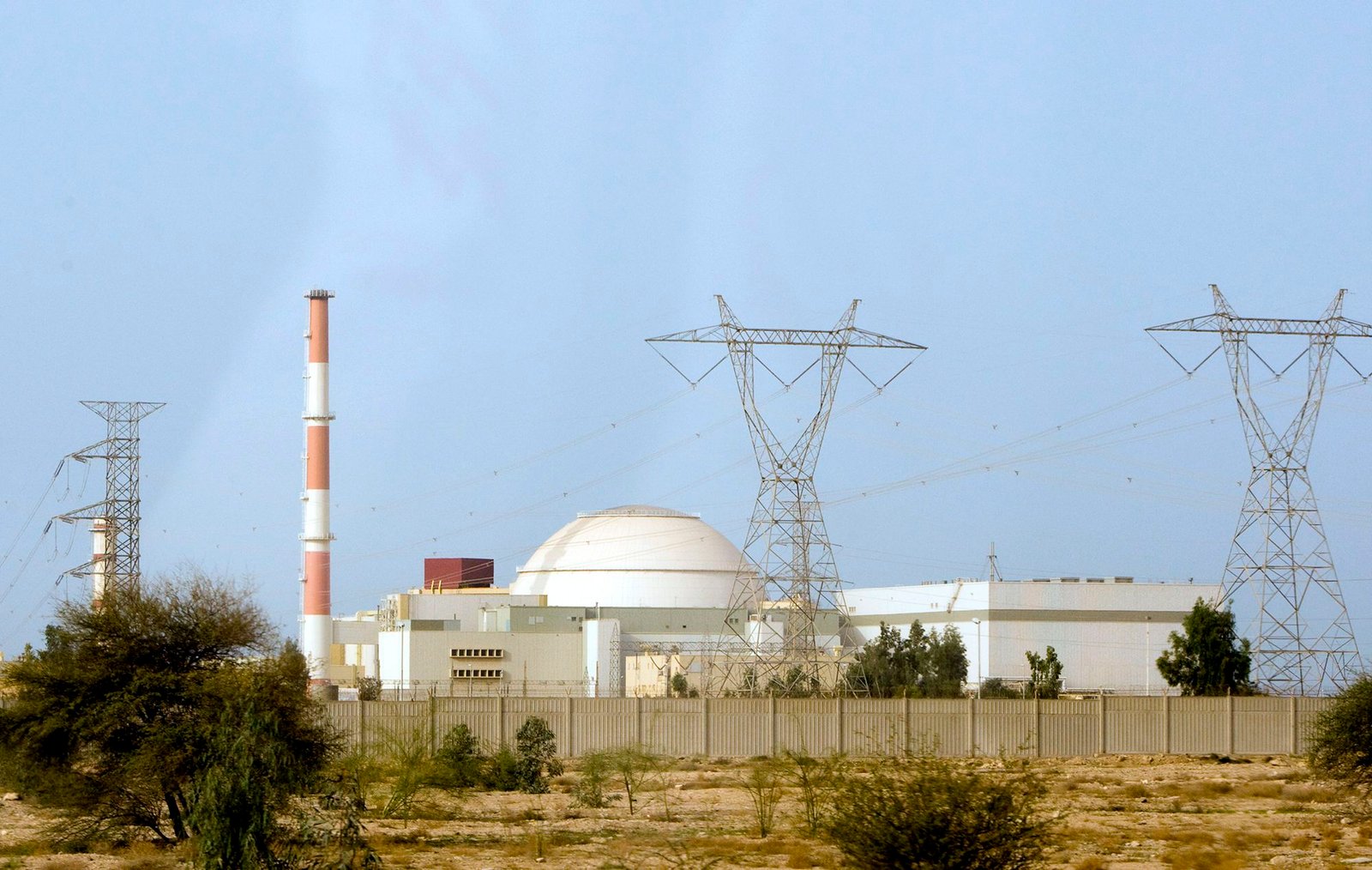
The first weeks of the 2026 war have also seen projectiles – of unclear origin – land close to Iran’s Bushehr nuclear power plant (NPP) at least four times. These four incidents occurred in just three weeks, with one projectile falling only 75 metres from the site perimeter.
Following one instance, Iran alleged to the International Atomic Energy Agency (IAEA) that ‘one of the site’s physical protection staff members was killed by a projectile fragment and that a building on site was affected by shockwaves and fragments’.
The Bushehr facility, which is operated by Russian state nuclear operator Rosatom, still hosts Russian staff members, although multiple waves of evacuations have reduced the numbers of Russian staff by about 500 personnel. The plant’s current operational state is unclear.
A 2021 study modelling a spent fuel fire at Bushehr notes a ‘small but significant risk’ that one or more major cities and other settlements in the region would ‘receive levels of fallout that would contaminate food and water supplies and require relocating large numbers of people’.
Power plants on the front line
The US-Israeli counter-proliferation strikes in Iran – and the subsequent Iranian targeting of Dimona – have followed Russia’s long-standing efforts to manipulate civil nuclear risks in Ukraine.
In the early days of Russia’s full-scale invasion of Ukraine, Russian forces seized the Zaporizhzhia NPP in a gun battle, setting one of the buildings on fire. The Russian soldiers had no expertise in operating a nuclear plant and held Ukrainian engineers hostage to operate the facility.
The reactors were placed into cold shutdown, dependent on offsite water and electricity supplies to keep stored spent fuel cool and to prevent a fire.
Since then, the Russian occupation of the plant has continued, amid frequent nearby military action severing the site’s power supply, repeated allegations of false-flag activity, and with the Ukrainian workforce persevering under constant pressure, strain and trauma.
The plant’s offsite power connection was last severed at the end of March, with the site continuing to rely on a backup offsite power connection until that too was cut on 14 April, with the site then relying on diesel generators for the 13th time since the war began, this time for a 90-minute period before offsite power was restored.
Following discussions with Russian President Vladimir Putin about the plant in late 2022, IAEA Director General Rafael Grossi noted that the president ‘knew it all very precisely … down to the technical details’. The plant – and manipulating risk there – seems to have played an outsized role in Putin’s thinking.
Russian hybrid activities in Europe have also seemingly demonstrated an interest in nuclear sites, including civil sites. Interest in these sites has been seen alongside those hosting European states’ nuclear weapons and dual-capable aircraft.
A spate of drone flights has been seen over nuclear weapons bases, including over the Île Longue nuclear-submarine base, which hosts France’s nuclear-powered ballistic-missile submarine (SSBN) fleet. Drones were also observed over Kleine-Brogel Air Base in Belgium on consecutive nights in early November 2025, and over Volkel Air Base in the Netherlands in the same month.
Drone flights have also been seen around civil nuclear sites, including around Belgium’s Doel NPP in November 2025.
Heightened concerns over the interest in nuclear infrastructure have grown against a background of Russia’s increasingly active campaign of sabotage targeting critical infrastructure, transportation, energy and other sectors, seeking to destabilise European governments, undermine public support and weaken NATO’s collective response.
While this effort has largely focused on less critical targets, there may be incentives for Russia to target nuclear infrastructure. The existing sabotage campaign has echoes of Soviet intelligence’s covert operations, when elements of the same intelligence agencies viewed NPPs as targets for attack in the event of conflict during the Cold War.
Risks and the nuclear future
The broad consensus over ‘nuclear security’ – the securing and responsible custodianship of civil nuclear materials – has been eroded. This consensus developed from the 1970s and was solidified in the post-9/11 environment and through a series of multinational Nuclear Security Summits between 2010 and 2016.
Nuclear security, however, was always focused on securing materials from non-state actors and terrorists, preventing theft of material and sabotage, rather than on state threats.
In Ukraine, Russia – formerly a major partner in securing nuclear materials – has been at the forefront of manipulating nuclear risks for its own ends at Zaporizhzhia.
Whether through a deliberate state attack on a nuclear facility or through miscalculation, the risk of a nuclear safety or security event with damaging effects is growing. This could involve the release of ionising radiation. However, a more likely scenario would be a smaller-scale incident undermining public confidence in the safety and security of nuclear materials.
This could still have important strategic effects. After the 2011 Fukushima accident in Japan, and following pressure from the anti-nuclear movement, Germany decided to close its nuclear reactors, which were fulfilling a quarter of the country’s energy needs at the time.
Nuclear power, alongside renewables, has been important in the energy mix as Europe has sought to wean itself off Russian gas since 2022, and in the light of a coming energy crisis as Iran and the US face off over the Strait of Hormuz. Indeed, European Commission President Ursula von der Leyen noted in March 2026 that she believes ‘it was a strategic mistake’ for Europe to turn its back on nuclear power.
Interest in SMRs is growing in Europe and beyond, with the technology lowering the costs of entry to nuclear power and potentially enabling reactors to be deployed in more locations and contexts as soon as the 2030s.
With SMRs likely to play a key role in powering data centres and energy infrastructure, and possibly with microreactors powering military bases in the future, there will be risks of nuclear collateral. However, while dependent on specific SMR designs, the scale of any radiological release from these smaller reactors would likely be much smaller than from a large conventional NPP.
Beyond the widespread targeting of military installations, in the first week of the current war Iran deliberately targeted data centres, hitting two and just missing a third, apparently with Shahed 136 drones, as well as oil and gas infrastructure, with widespread impacts across the Gulf.
In this nuclear future, the interface between nuclear technology, conflict and hybrid activity is likely to increase worldwide. As are the opportunities for states to deliberately manipulate nuclear risks and weaponise public concern.