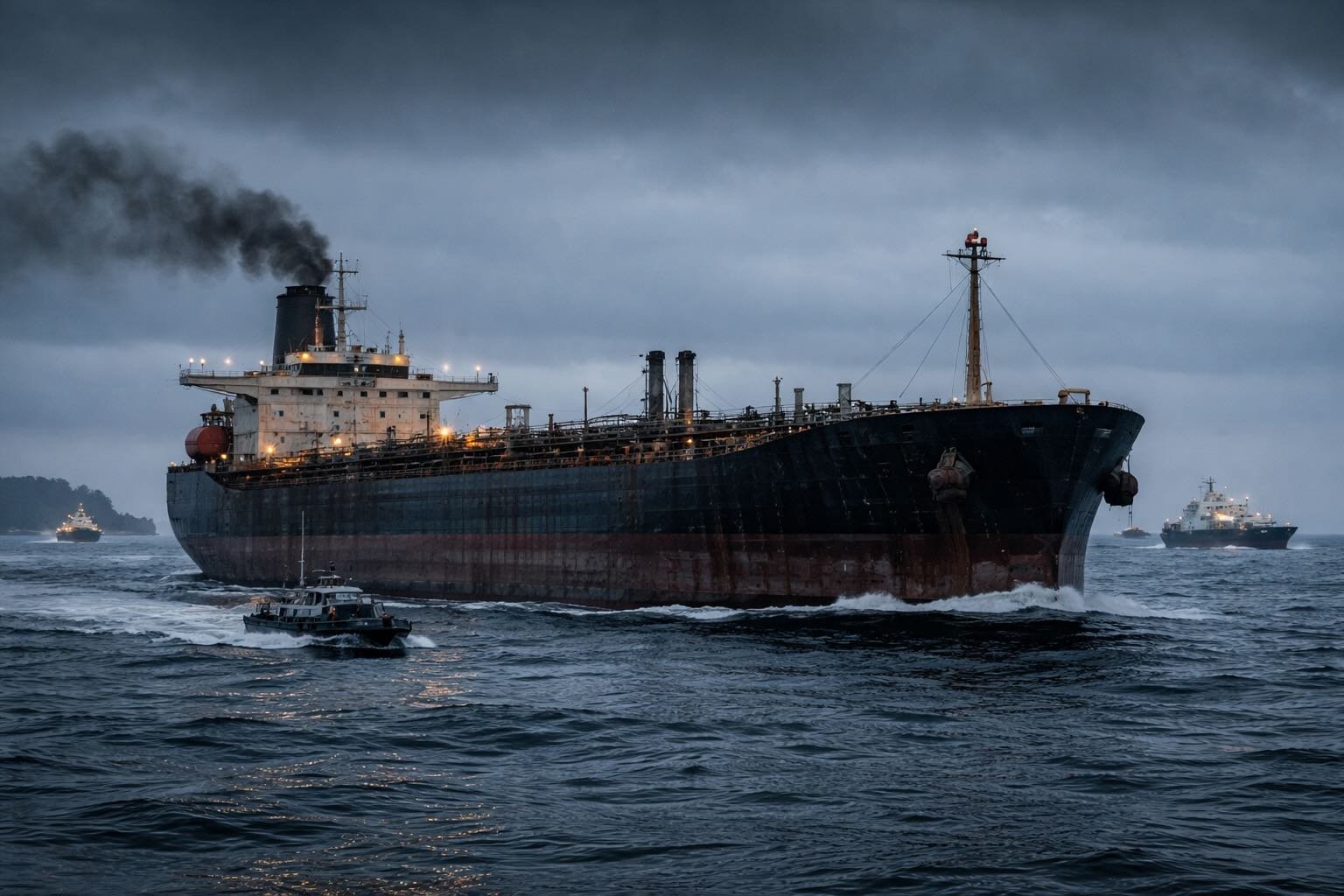
European states are moving from symbolic boardings towards sustained maritime law enforcement intended to disrupt Russia’s shadow fleet and raise the costs of sanctions evasion. The consequences for NATO are significant and will likely shape Alliance deterrence and escalation risk in the future.
On 6 March 2026, the Swedish Coast Guard took control of the cargo vessel Caffa in Swedish territorial waters off Trelleborg in the Baltic Sea and launched an investigation into the vessel’s seaworthiness. The coastguard’s action followed swiftly on the heels of Belgium’s armed forces which, together with the French, intercepted and boarded the shadow-fleet tanker Ethera in the North Sea. Belgian prosecutors said the vessel was suspected of sailing under a false flag and carrying forged documents. The boarding followed a 26 January statement by Baltic and North Sea coastal states that raised concerns about the deterioration in maritime safety in the region, and warned about global-navigation-satellite-system interference, automatic-identification-system data manipulation, and the risks posed by sanctions-evasion shipping.
Operation Blue Intruder (the Belgian operation to board the Ethera) suggests European NATO member states have decided to adopt a more assertive enforcement posture beyond the Baltic. This shift builds on earlier actions such as the interdiction of the Grinch by French forces in January 2026. Its subsequent detention and the penalty fine to release the vessel set a new precedent by a European NATO member state disrupting sanctions evasion. The Grinch, a crude-oil tanker owned by the Moscow-based Argo Tanker Group and flying under the Comoros flag, was boarded by French naval commandos in the Alboran Sea before being escorted to Marseille-Fos port area.
As of early March 2026, the United States (supported by the United Kingdom) and at least eight European coastal states had boarded, detained or seized Russian-linked vessels. Belgium, Finland and France have seized or detained shadow-fleet tankers, while Germany, Italy, Latvia, Norway and Sweden have executed boardings or detentions of cargo and bulk vessels suspected of sabotage, espionage, or sanctions violations.
These actions by European coastal states have, in some cases, forced the Kremlin to adapt by reflagging shadow-fleet tankers to the Russian registry to claim sovereign protection, while occasionally deploying military escorts. In late January 2026, the General Skobelev, a Russian military-linked product tanker, was escorted through the English Channel by a Russian corvette. The Kremlin’s aim does not seem to be to protect every shadow-fleet tanker with a military escort but to shape Europe’s perception of its intent to do so, and thereby to protect what it considers to be its most valuable vessels, and raise the political cost of interdiction. Even where enforcement is undertaken nationally and outside a formal NATO framework, the consequences for the Alliance are significant. The Kremlin’s signalling will be aiming to test political cohesion, amplify the threat of escalation, and deter further action by NATO member states in contested waters.
Policing in contested waters
The use of the shadow fleet and, separately, cargo and bulk vessels for sabotage, espionage, or sanctions violations presents European coastal states with a dilemma. While there has been an increase in the disruption of the shadow fleet, concerns among European capitals range from the risk that routine enforcement could tip into military confrontation, to the more prosaic constraint of limited maritime assets and investigative capacity. A concern for NATO will be that few European capitals can sustain a high-tempo posture for long, leaving random boardings looking potentially escalatory without being strategically decisive.
By reflagging and occasional escorts, the Kremlin is seeking to blunt the ‘without nationality’ clause in Article 110 of the United Nations Convention on the Law of the Sea that some states have relied on to justify high-seas boardings, and to force enforcement agencies away from high-seas interventions and back towards the slower, resource-intensive tools of port-state control and coastal-state enforcement. Such a dilemma has left some European capitals unable to decide on engaging the shadow fleet, despite the impact this is having in support of Russia’s wartime economy. For instance, in January 2026, 42 sanctioned oil tankers travelled through the English Channel. The overall volume of illicit traffic remains immense, with over 9,500 Russian tanker voyages recorded through the Strait of Dover over the past four years. What is clear is that uneven enforcement has eroded both the credibility of the sanctions regime and NATO’s deterrence posture in contested waters such as the Baltic Sea, the English Channel and the North Sea.
Other options do exist to NATO member states, including the use of legal, environmental and administrative tools against Russia’s shadow fleet. It has long been accepted that Russia’s shadow fleet is rapidly ageing: the average age of its vessels is approximately 18 years and they could likely be detained under an environmental protection mandate – principally due to their lack of credible protection and indemnity insurance. In January 2026, German officials demanded that the shadow-fleet tanker Arcusat provide insurance documentation and flag status. On being challenged and denied entry into German territorial waters, the tanker changed course and sailed north toward Russia’s Arctic coast.
Port State Control mechanisms, the ‘inspection of foreign ships in national ports to verify that the condition of the ship and its equipment comply with the requirements of international regulations’, as well as criminal investigations, have also been used to inspect and impound ships, which has led to the discovery of broader sanctions violations. For example, on 31 December 2025, Finnish special forces seized the cargo ship Fitburg in the Gulf of Finland under the pretext of investigating damage to an undersea telecommunications cable. Once aboard, Finnish Customs officers discovered that the Fitburg was transporting a cargo of Russian structural steel, prohibited under European Union sanctions, en route from St Petersburg to Israel. Last month, the Italian Guardia di Finanza and customs officials seized the bulk carrier Hizir Reis in Brindisi and detained the vessel for illegally carrying 33,000 tonnes of Russian ferrous material, in direct violation of EU sanctions.
All at sea
As the UK and other European coastal states weigh up the risks of interdicting Russia’s shadow fleet, the timing of new enforcement activity matters. With the war in the Middle East already inflating energy prices, any further disruption to oil flows carries heightened political risk. The challenge, therefore, will be how the Alliance prepares for a Russian response that is unlikely to be orthodox, as Russia’s ability to project conventional surface power is already constrained. A more likely response by the Kremlin will be to continue applying asymmetric pressure aimed at deterring further enforcement: interference with maritime situational awareness, harassment and intimidation around boarding operations, sabotage and cyber activity against ports and critical infrastructure, and lawfare designed to complicate jurisdiction and raise political costs.
The EU, the UK and G7 partners have projected unity through sanctions policy, while NATO has reinforced the wider resilience and deterrence context in which enforcement takes place. But at sea the operational response has varied significantly. As pressure on the shadow fleet intensifies, European coastal states have scope to impose more consistent costs, underpinned by a clear enforcement strategy, while managing escalation risk and avoiding an unintended military confrontation. If they do not, the likely outcome is a pattern of hesitant, fragmented action that erodes deterrence and invites the Kremlin to test Alliance cohesion in contested waters.