The return of large-scale war to Europe, alongside nuclear threats, China’s rise, the collapse of arms-control treaties, and shifts in US policy under Trump, have increased European doubts about relying on American protection. This reinforces France’s long-standing view that Europe should ensure its own security rather than depend solely on the United States.
Emmanuel Macron’s final presidential speech on nuclear deterrence, delivered at the Île Longue naval base on 2 March 2026, marked a significant evolution in French nuclear strategic thinking and for deterrence in Europe. While Macron emphasised that Paris’s position on nuclear autonomy remained unchanged, notable points of departure included a new doctrine of ‘forward’ deterrence, designed to enhance collaboration with regional neighbours.
Soon after Russia’s 2022 invasion of Ukraine, France reportedly deployed three of its four Le Triomphant-class nuclear-powered ballistic-missile submarines (SSBNs) simultaneously for several days. This was the most ambitious French submarine deployment in over three decades and represented a technical and operational feat for the navy. At the time, France and Russia were engaged in direct, leader-level crisis diplomacy by telephone. Paris thus intended the naval deployment to communicate both that its sea-based nuclear deterrent remained credible and that French President Emmanuel Macron intended to be taken seriously.
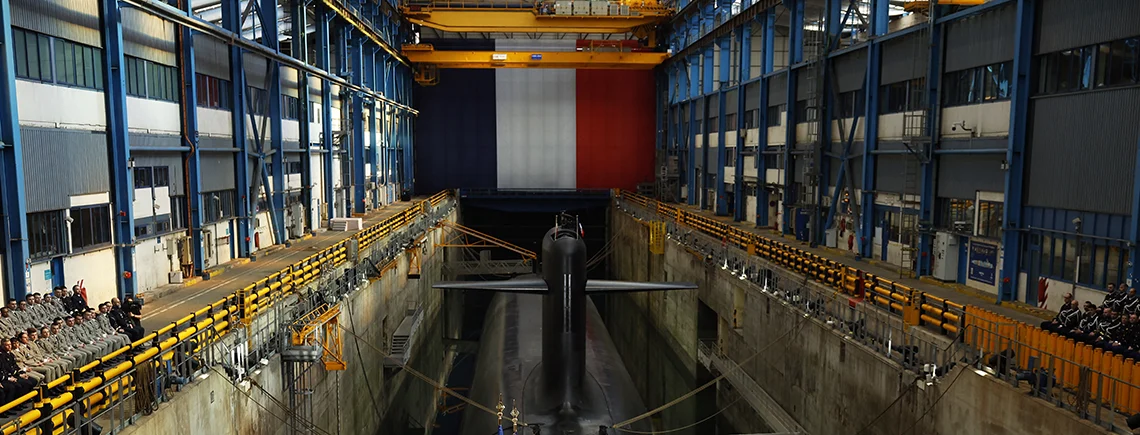
As if echoing that period, a dry-docked French SSBN served as the dramatic backdrop for Macron’s second, and last, presidential speech on nuclear deterrence, which occurred at the Île Longue naval base on 2 March 2026. The undercurrent of the speech was that the world had changed profoundly since he had last given a major address on nuclear issues in February 2020.
Europe’s deterrence problem
The return of large-scale conventional war to Europe, under the shadow of nuclear threat, has been compounded by China’s military rise, the disappearance of arms-control treaties and the strategic realignments following from Donald Trump’s return to the presidency of the United States. Though Washington insists that the US nuclear umbrella remains intact, Trump has not only questioned the United States’ protection of Europe but even gone so far as to threaten to seize the sovereign territory of a NATO member, Denmark. Paris has seen these developments as validating France’s long-held Gaullist position – that Europe should not rely on American power alone for its security. For this reason, France’s neighbours have expressed a growing interest in French nuclear deterrence, which could serve as a safety net if Washington defected, and in the United Kingdom’s nuclear deterrent, which is operationally independent from Washington, even if it has been partly designed in cooperation with the US and relies on American parts and maintenance.
France’s neighbours have expressed a growing interest in French nuclear deterrence, which could serve as a safety net if Washington defected[.]
It was this observation that formed the basis of the Northwood Declaration in July 2025: Paris and London now offer their partners a joint security guarantee against a potential ‘extreme threat to Europe’ and have raised the possibility of joint nuclear planning. The first meeting of the France–UK Nuclear Steering Group took place in December 2025, and British observers attended the French nuclear exercise Operation Poker in September 2025.
The shifts announced in the Île Longue speech follow decisions taken by Macron and former president François Hollande over the course of more than a decade to guarantee the sustainability of French nuclear deterrence through to 2035 and beyond. These shifts include the launch of the third generation of SSBNs and the fourth version of the M51 submarine-launched ballistic missile (M51.4). The current M51.3 has a range of approximately 10,000 kilometres according to the French Ministry of the Armed Forces. It is equipped with the second iteration of warheads produced by the French nuclear defence ‘simulation’ programme, the TNO-2 (Tête Nucléaire Océanique-2). Presidential decisions also included the launch of the ASN4G (Air-Sol Nucléaire de 4ème Génération) programme, a hypersonic missile that is projected to equip the Strategic Air Forces’ Rafale F5s in the mid-2030s. France currently has two squadrons of over 20 Rafale fighter jets, and a flotilla of Rafale on the nuclear-powered Charles de Gaulle aircraft carrier that can also hold nuclear missiles, though they do not in peacetime.
The European dimensions of French deterrence
Macron’s speech contained several elements that had been expected by analysts:
- that French nuclear sovereignty regarding launch authority cannot be shared;
- that deterrence is reserved for ‘extreme circumstances’, and solely for the protection of ‘vital interests’, in particular the defence of national territory, including overseas possessions; and
- that France continues to reserve the right to issue a single, non-renewable ‘nuclear warning’ before proceeding, if necessary, to an unrestrained nuclear strike on enemy territory.
The speech also included implicit messages to Russia (that its size is irrelevant given the destructive power of the French nuclear arsenal) and to China and North Korea (that they are not so far away as to be beyond the reach of French capabilities).
Several significant new developments were outlined in the speech. While French deterrence still protects the country’s ‘vital interests’, it will now be possible to deploy strategic assets outside national territory and to have non-nuclear partners assist in deterrence activities. Allies are also called upon not only to participate in French nuclear exercises but to ‘support’ French deterrence through their contributions to functions such as early warning and anti-aircraft and anti-ballistic defence. This is what Macron referred to as ‘in-depth’ or ‘forward’ deterrence (dissuasion avancée). France will remain entirely in control of its nuclear decisions, and Macron was keen to emphasise that he was not providing any kind of automatic nuclear ‘guarantee’ of protection for France’s neighbours. Macron also did not announce any permanent stationing of Rafale aircraft – even without warheads – outside mainland France.
While French deterrence still protects the country’s ‘vital interests’, it will now be possible to deploy strategic assets outside national territory and to have non-nuclear partners assist in deterrence activities.
This forward deterrence is meant to complement that of NATO, not compete with it. The first countries to volunteer to participate in this new strategy form an arc from northeast to southeast Europe, from Sweden to Greece. Germany has been singled out: not only did Macron emphasise the necessity of ‘the survival of … [France’s] closest partners’ in his speech, but a Franco-German communiqué published shortly after confirms the special treatment reserved for the country, with which a steering group on these issues will be created. No such steering or consultative multilateral body has been announced yet, however.
In a crisis, such a dispersal of aligned countries (Macron referred to it as an ‘archipelago’) would also have a military advantage for France: it would prevent the enemy from easily destroying French air assets and would complicate targeting decisions. It would also shorten flight times to Russia. The contours of a European nuclear-deterrence architecture now appear more clearly: at the front, French and allied assets, and at the rear, or rather at sea, a Franco-British partnership under the Northwood Declaration guaranteeing the ultimate security of the continent.
Another important development is that France appears to be breaking with its concept of ‘sufficiency’. This French version of ‘minimum deterrence’ suggested that the country would maintain the smallest possible arsenal consistent with its deterrence needs, foregoing, for instance, a posture organised around counterforce targeting. For the first time in decades, this term did not appear in an official French pronouncement about deterrence.
Furthermore, Macron announced an increase in the size of the French arsenal. (The UK announced in 2021 that it would raise the maximum number of warheads in its own arsenal.) This may have been prompted by the need to account for the modernisation of Russian defences or the possibility of a Russia–China alliance against the continent. But the European dimension is important here: announcing a stronger nuclear posture in the form of an increased arsenal could be a way for France to both reassure Europeans and eventually provide allied aircraft with the possibility of one day carrying French missiles. This may be one reason why the term ‘sufficiency’ was not used.
Finally, Macron also did not mention two traditional concepts of French doctrine: the notion of ‘unacceptable damage’ that would be inflicted on the adversary’s territory and the more recent specification that this would come through the targeting of ‘centres of power’. Instead, he referred to strikes that would ensure the targeted state would ‘not recover’.
Ambiguities and deliberate omissions
The speech treated some issues with a new and deliberate lack of clarity. For instance, Macron offered no details regarding the scope of French vital interests, whereas other official statements have referred to ‘core vital interests’ as being French territory, population and sovereignty. The term ‘self-defence’ was also absent from the speech – as in ‘extreme circumstances of self-defence’, an expression which originated in a 1996 International Court of Justice advisory opinion regarding the legality of the threat or use of nuclear weapons. Moreover, Macron did not provide any numbers or characteristics of current or future French forces, to the probable chagrin of non-nuclear states and non-governmental organisations calling for greater ‘transparency’ and ‘accountability’.
There were five notable omissions from the speech. Firstly, Macron did not address explicitly the intertwining of European and Asian security as evidenced by the deployment of North Korean forces in Russia. He did suggest that a conflict in Asia would not ‘be without consequences’ for French interests. But given the risk of a possible future conflict over Taiwan and North Korea’s interest in asserting itself as a nuclear power, a few more details would have been expected.
Secondly, Macron did not say whether the ‘strategic’ assets deployed in Europe could include nuclear weapons, nor did he clearly state whether the countries concerned could one day participate directly in a French nuclear raid using air-defence aircraft, for instance. He also did not explicitly repeat two of his ‘red lines’ expressed in May 2025: France will not finance the security of others and the terms discussed with allies will not detract from France’s needs.
Thirdly, the French president did not elaborate on his statement that a country targeted by France with a massive strike could ‘not recover’. This leaves France open to criticism, or at the least questions, regarding whether Paris is again targeting cities or even population centres in its planning.
Fourthly, Macron gave no details on the projected format of the French nuclear forces by 2035. Several points remain ambiguous. It is unclear whether the modernised nuclear air base to be opened in a few years at Luxeuil will host the existing two Rafale squadrons or whether new squadrons will be created. Macron did not address the diversity of planning options open to French leaders, including the flexibility of arsenal management, the possibility of ‘mixing and matching’ missile allocations or the option of firing some but not all missiles loaded onto an SSBN. A recurring question for allies regarding the possibility of France (and the UK) extending some form of nuclear protection for the continent relates to the country’s capabilities, particularly whether it has the volume and type of arsenal necessary to extend deterrence.
Lastly, the French president did not unpack a concept he raised at the Munich Security Conference in February 2026, in which he linked nuclear deterrence to ‘a holistic approach’ to defence and security. This would have been informative given widespread perceptions outside of France that French thinking about deterrence is limited to the nuclear domain.
Outlook
Reactions to the speech were mostly favourable in Europe, and particularly in France. But allies understandably wonder what Macron’s successor, to be elected in 2027, will do in this domain. Some anticipate that a potential far-right National Rally president would seek above all to project an image of responsibility and respectability, along with continuing to uphold the legacy of Charles de Gaulle, who believed that France’s vital interests were not limited to its national territory.
Macron sought to reassure French voters that not only would there be no sharing of the decision to use nuclear weapons, but there would also be no sharing of the definition of vital interests and nuclear planning.
Macron sought to reassure French voters that not only would there be no sharing of the decision to use nuclear weapons, but there would also be no sharing of the definition of vital interests and nuclear planning. This seems to have worked: the opposing National Rally party was less negative than anticipated. A rather sober statement issued by party leaders Marine Le Pen and Jordan Bardella following the presidential speech merely questioned the relevance of ‘forward deterrence’, without accusing Macron of betrayal in this area, as some feared. While the next president may not be keen to advance the Europeanisation of deterrence further, it is doubtful that they would significantly upend Macron’s legacy on this issue.