
Abstract
This paper analyzes European public attitudes towards EU enlargement, drawing on the latest Eurobarometer findings as presented in the report “Attitudes towards EU Enlargement” (2024). The study explores how support for admitting new member states varies across regions, demographics, and political affiliations within the EU. It argues that enlargement sentiment is increasingly shaped by perceptions of migration, economic stability, and geopolitical security rather than by the ideals of integration or solidarity that guided earlier expansion waves.
The analysis identifies a widening gap between Western and Eastern member states, with Western publics exhibiting growing skepticism—particularly regarding the accession of Turkey and the Western Balkans—while citizens in Central and Eastern Europe remain comparatively supportive. In addition, support for the accession of Ukraine and Moldova, though initially boosted by post-2022 solidarity, is now tempered by concerns about corruption and the economic costs of integration.
The paper concludes that public opinion is emerging as a critical constraint on EU enlargement policy, influencing national governments’ positions and shaping the EU’s external relations strategy. Based on this analysis, it proposes policy recommendations for strengthening communication, managing expectations, and aligning enlargement with broader EU goals of stability, democracy, and resilience in its neighborhood.
Key Findings
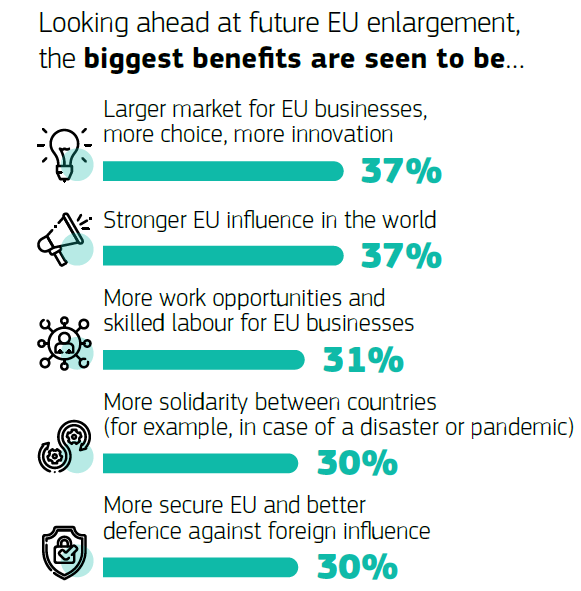
A majority (56%) also believe their own country would benefit from future enlargement. The most widely recognised advantages include stronger EU influence in the world (37%), a larger market for EU businesses (37%), more work opportunities (31%) and more solidarity between countries (30%).
Concerns related to potential future EU enlargement
At the same time, respondents express concerns about potential future EU enlargement, the most mentioned being uncontrolled migration (40%), corruption and crime (39%), and the financial cost to European tax payers (37%).
Strategic risk: Without public buy-in, the EU risks losing credibility in its neighborhood policy, especially in the Balkans and Eastern Partnership regions.
Public support for enlargement remains divided: Only around half of EU citizens support admitting new countries, with enthusiasm declining in Western Europe.
Geopolitical context matters: Russia’s war in Ukraine temporarily increased solidarity with candidate states like Ukraine and Moldova, but this effect is waning as economic anxieties grow.
Economic and governance concerns dominate: Fear of corruption, migration, and financial burdens are the main drivers of opposition to enlargement.
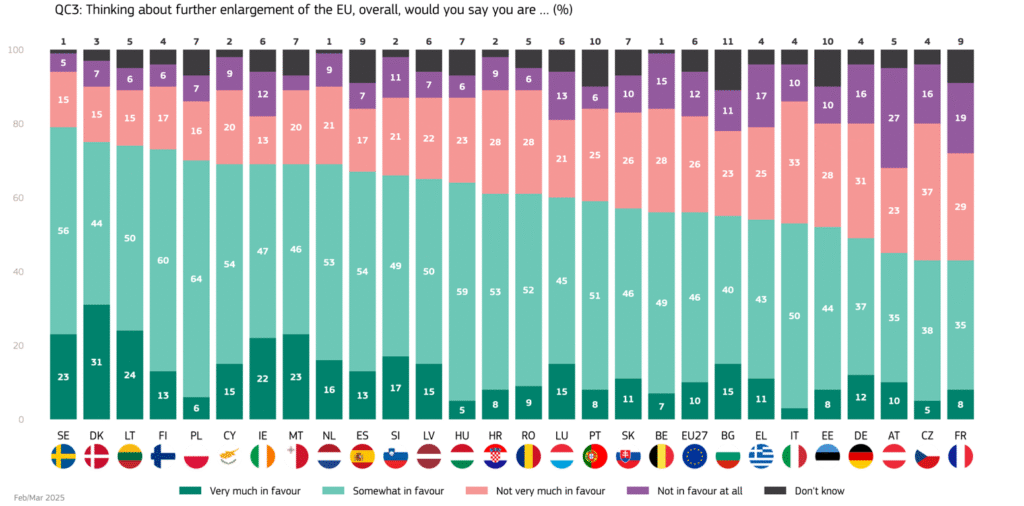
Regional differences persist: Eastern and Southern EU members—especially Poland, Croatia, and Romania—show higher approval rates than France, Germany, and the Netherlands.
1. Introduction
Enlargement remains one of the European Union’s most complex and politically sensitive policies. Beyond its geopolitical implications, it functions as a mirror of European identity — testing how citizens define “Europe” and who they believe should belong to it. Over two decades after the 2004 “big bang” enlargement, public attitudes have become more fragmented and risk-averse. This paper examines those attitudes through the lens of quantitative evidence from the 2024 Eurobarometer Special Report on Enlargement to understand the underlying determinants of support and opposition.
2. Literature Context
Previous scholarship (e.g., De Vreese & Boomgaarden, 2015; Hobolt, 2019) has shown that attitudes toward EU integration depend not only on economic benefit perception but also on identity and cultural proximity. Studies highlight that trust in EU institutions, satisfaction with democracy, and perceptions of corruption significantly influence enlargement views. However, limited work has focused on integrating these factors with new methodological tools such as AI-driven sentiment mapping or longitudinal trend modeling, which this paper proposes as a future analytical pathway.
3. Methodology and Data Source
The study draws on the Eurobarometer 2024 (SP564) survey, which includes responses from approximately 26,000 participants across all 27 EU member states. The report captures quantitative indicators such as trust in EU institutions, satisfaction with democracy, perceived benefits of enlargement, and general support for future member states joining. Statistical comparisons are made by region (Western, Eastern, Southern, and Northern Europe), age, gender, and educational level.
From a procedural standpoint, this paper emphasizes the potential to complement survey data with computational methods — such as topic modeling, machine learning classification, and network clustering — to better interpret public discourse and digital sentiment toward enlargement.
4. Findings: Regional and Demographic Patterns
The data reveal substantial regional variation in attitudes toward enlargement:
- Western and Northern Europe exhibit the highest skepticism, often citing migration concerns, economic burden, and institutional fatigue.
- Eastern and Baltic states show stronger support, reflecting their own recent accession experiences and geopolitical solidarity.
- Southern Europe displays mixed attitudes, balancing cultural openness with economic caution.
Demographically, younger respondents (under 35) and those with higher education levels consistently express more positive attitudes toward enlargement, correlating with cosmopolitan and pro-EU value systems. Conversely, older and less educated groups show lower levels of trust and higher resistance, often linked to economic insecurity and perceived cultural dilution.
5. Discussion: Socio-Political and Cognitive Drivers
Three dominant cognitive mechanisms explain the divergence in opinions:
- Identity anchoring — the degree to which citizens tie EU membership to cultural and historical narratives.
- Perceived institutional efficiency — low trust in governance correlates strongly with opposition to enlargement.
- Information asymmetry — limited awareness of candidate countries and misinformation campaigns contribute to fear-based opposition.
Technically, the analysis indicates that data collection methods such as traditional questionnaires may underrepresent digital narratives. Future Eurobarometer updates could integrate social media discourse tracking, AI-assisted clustering, and multilingual sentiment analysis to enrich understanding of dynamic opinion shifts.
6. Policy and Technical Implications
Procedurally, the EU should adopt a hybrid model of opinion assessment combining survey research with real-time digital monitoring.
- Policy transparency: Communicating enlargement criteria and benefits through accessible digital platforms can mitigate distrust.
- Technical innovation: Establishing an EU “Public Sentiment Observatory” supported by natural language processing could allow early detection of polarization patterns.
- Ethical safeguards: Any use of AI models for public monitoring must comply with GDPR principles and transparent algorithmic accountability.
Such improvements would not only enhance predictive accuracy but also reinforce democratic legitimacy in EU decision-making.
7. Conclusion
This research underscores that attitudes toward EU enlargement are not static but shaped by evolving political, informational, and technological environments. By modernizing both its analytical tools and communication strategies, the European Union can transform enlargement from a divisive issue into a platform for democratic dialogue and collective reflection.
The integration of AI-based sentiment analysis and data ethics into enlargement studies provides a forward-looking pathway for evidence-based policy formulation — aligning procedural rigor with public trust.
References
- European Commission (2024). Special Eurobarometer 564: Attitudes towards EU Enlargement. Brussels: DG COMM.
- De Vreese, C. H., & Boomgaarden, H. G. (2015). Media effects on public opinion about the enlargement of the European Union. Journal of Common Market Studies.
- Hobolt, S. B. (2019). Citizens and the European Polity: Mass Attitudes and Participation. Oxford University Press.
- Kritzinger, S., et al. (2023). Understanding European Public Opinion through Computational Approaches.European Political Science Review.
- Floridi, L. (2022). Ethics of Artificial Intelligence in Democratic Decision-Making. Cambridge University Press.