Following this weekend’s Munich Security Conference, one conclusion is unavoidable: a year into Donald Trump’s presidency and four years after Russia’s full-scale invasion of Ukraine, Europe must be able to organise its own defence without relying on the United States.
US Under Secretary of War for Policy Eldridge Colby told NATO defence ministers, in Brussels, last week that “NATO 3.0 requires much greater efforts by our allies to step up and assume primary responsibility for the conventional defence of Europe”. While he reaffirmed Washington’s commitment to the Article 5 mutual defence clause and to extended nuclear deterrence for Europe, few believe that Trump would put the US homeland at risk if Russian President Vladimir Putin were to seize the Russian-speaking border town of Narva in Estonia, or Norway’s Arctic Svalbard archipelago.
Defending Europe conventionally without the US demands many things – military capabilities, ammunition and spare parts, command and control systems, training and exercising, larger armed forces, logistics for military mobility, and resilient energy, communications and transport networks. But it also requires a leadership structure capable of taking timely and effective decisions to combat and repel aggression. If Europe is to spend much more on defence and take prime responsibility of its own security, how and where are the crucial decisions to be taken?
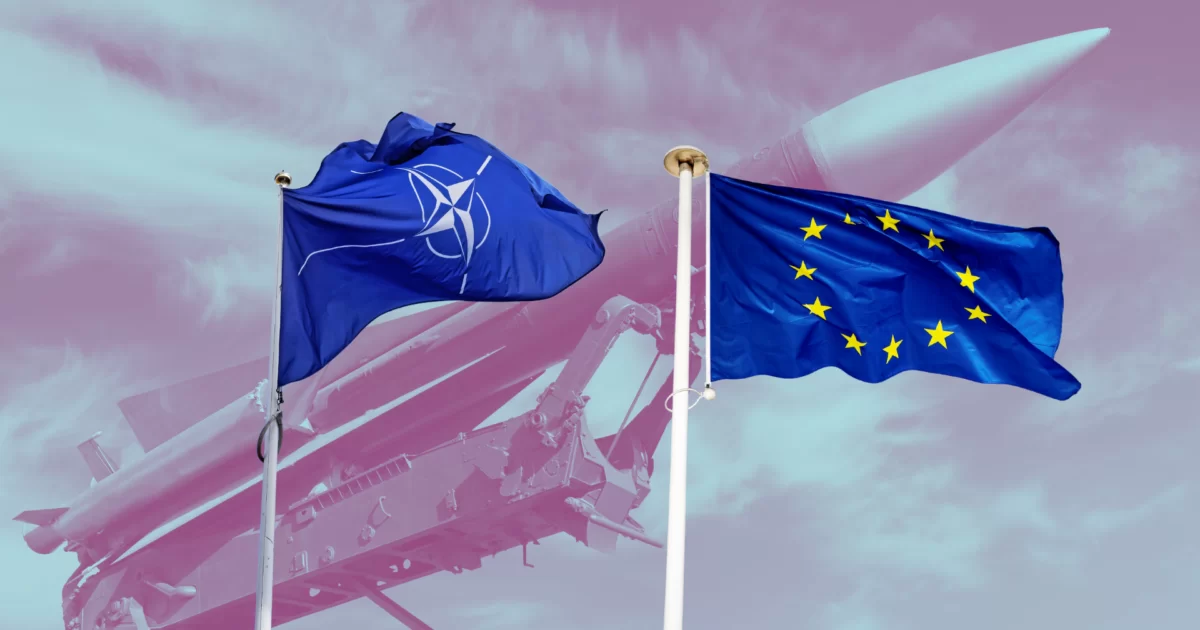
The war in Ukraine has demonstrated that neither the EU nor NATO is able to fulfil that role. Both organisations are hobbled by the unanimity rule and include members with a track record of obstructing collective action.
While NATO reinforced its eastern flank and stepped-up air and naval patrols after Russia’s 2022 invasion of Ukraine, the Biden administration and west European governments kept NATO out of any direct involvement in supporting Ukraine. Supplies to Kyiv were organised instead through an ad hoc US-led Ukraine Support Group. NATO rebuffed appeals from President Volodymyr Zelenskyy to enforce a no-fly zone over Ukraine for fear of direct hostilities with a nuclear-armed Russia.
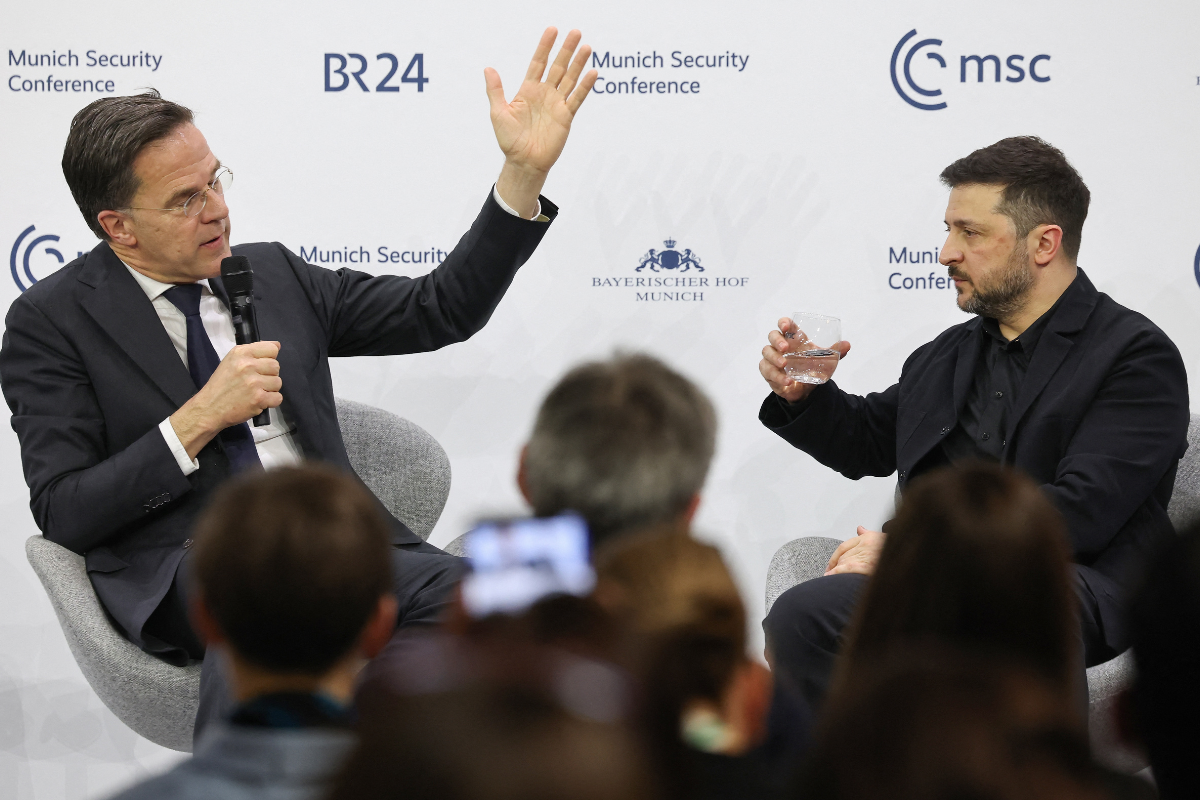 Photo credits: Photo by ALEXANDRA BEIER / AFP
The United States remains the dominant power in NATO. If Washington does not want the alliance to handle an issue, it does not. The return of Trump to the White House and his rapprochement with Russian President Vladimir Putin meant NATO could not be used to plan and implement security guarantees for Ukraine in the event of a ceasefire agreement.
The EU, for its part, imposed swift economic and political sanctions on Russia and helped manage the transition away from dependence on Russian gas supplies. It organised financing for member states’ arms deliveries to Ukraine and training for Ukrainian troops and leveraged the EU budget to fund some joint procurement of weapons. However, pro-Russian Hungary slowed and weakened subsequent sanctions packages and blocked reimbursements for arms sent to Kyiv.
European Commission President Ursula von der Leyen spoke at the Munich Security Conference of “bringing to life” the EU’s own mutual assistance obligation – Article 42.7 of the Treaty on European Union, which is on paper more binding than NATO’s Article 5. However, the EU is not a defence organisation. It includes four neutral countries – Austria, Cyprus, Ireland and Malta – and two pro-Russian spoilers – Hungary and Slovakia. More importantly, it does not include three countries key for the defence of Europe – the UK, Norway and Türkiye. While it is essential to involve the EU’s financial, regulatory and political consensus-building capacities, the Union cannot be the fast and effective decision-maker on matters of war and peace.
It took an ad hoc structure, the coalition of the willing, outside both the EU and NATO, to assemble potential European security guarantees for Ukraine including the prospect of British and French ground forces in country but away from the front line, as well as multinational air and naval patrols. Whether, and to what extent, the US would provide intelligence, strategic enablers and backup forces in case of a Russian violation of the ceasefire remains to be agreed.
Led by European nuclear powers France and the UK, the Coalition includes 35 countries and organisations – including NATO and the EU, as well as Canada, Japan and Australia which are like-minded partners of Europe. It has a small embryonic operational command in Paris. It also includes Ukraine, which is not a NATO or EU member but has Europe’s biggest and most battle-hardened army. The US has attended Coalition meetings as an observer.
The Coalition is structured like an onion, with an inner core of the UK, France and Germany – Europe’s major military and economic powers — and a second ring including Italy, Spain and Poland, the other big European states. Nordic and Baltic countries, often represented by Denmark or Finland, are influential because of their location and strong defence commitment.
For now, the Coalition has no legal personality or secretariat, only a handful of detached UK and French officials and officers. However, it has the potential to grow into the nucleus of a European defence union, acting wherever possible through NATO military structures but, if necessary, under coalition command.
One option could be to revive the 1948 Brussels treaty that created the pre-NATO Western European Union, which was absorbed into the EU in 2010, to give a core European defence union a legal basis incorporating willing EU countries, the UK and Norway. That might take too long for current needs. But if Europe is to defend itself with limited — or perhaps no US assistance, a nimble body capable of shaping and taking rapid decisions in a crisis is essential. This de facto European security council looks like the best option.
Paul Taylor is a Senior Visiting Fellow in the Europe in the World Programme at the European Policy Centre.
The support the European Policy Centre receives for its ongoing operations, or specifically for its publications, does not constitute an endorsement of their contents, which reflect the views of the authors only. Supporters and partners cannot be held responsible for any use that may be made of the information contained therein.